JuicyTalk
Introduction
Vibe Coding is redefining the software landscape by harnessing artificial intelligence to make code creation faster, more intuitive, and accessible to virtually anyone. In 2025, this trend has moved from buzzword to mainstream, ushering in a new era where software projects ride on creativity and natural language—“the vibe”—not just technical know-how.
The Surge of Vibe Coding: Data and Adoption Trends
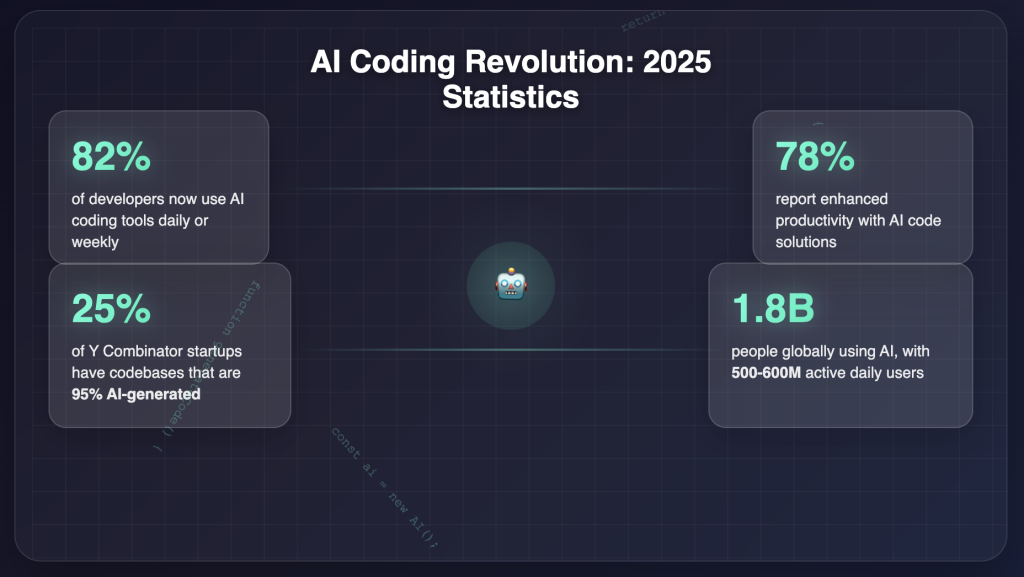
- 82% of developers now use AI coding tools daily or weekly, cementing AI’s place as a staple in 2025 developer workflows.
- Nearly 78% report enhanced productivity with AI code solutions, citing faster prototyping, easier testing, and more enjoyable work.
- Among the recent Y Combinator Winter cohort, 25% of startups had codebases that were 95% AI-generated.
- The market for consumer AI, including code generation tools, has soared, with over 1.8 billion people globally using AI (including for coding) and 500–600 million active daily users.
How Vibe Coding Works: Workflow Innovations
- Describe the Intent: Developers and non-coders explain goals using natural language, sketches, or even voice commands.
- AI Generation: Tools like ChatGPT, Claude, Cursor, Bolt.new, and Lovable generate functioning code, UIs, or databases.
- Iterate & Experiment: Quick cycles of user feedback and AI refinement yield rapid prototypes.
- Integrate & Deploy: Finished products are deployed in record time thanks to AI-powered DevOps and testing.
Key Drivers Behind the Trend
- Maturity of AI/LLMs: Advanced models (OpenAI, Anthropic, xAI) accurately interpret human intent and deliver robust solutions.
- Multimodal Inputs: Tools are evolving beyond text—voice, sketches, and UI mockups can be transformed directly into code or apps.
- AI-Native Environments: The rise of AI-native IDEs (Cursor, Windsurf) means AI is now deeply woven into every coding stage, not added as an afterthought.
Productivity Benefits and Statistical Impact
- Developers leveraging AI tools experience:
Leading Vibe Coding Tools of 2025
- Cursor: AI-native editor with deep codebase comprehension for professionals.
- GitHub Copilot: Used by over 15 million developers, excels at autocompletion and debugging.
- Replit Agent: Interactive agent capable of automating entire workflows.
- Lovable, Bolt.new, v0.dev: Transform UI mockups and sketches into code instantly.
- Claude, ChatGPT: Multimodal LLMs for text, visuals, even voice-driven development.
How Different Audiences Benefit
- Professional Developers: Automate repetitive/boilerplate work, focus on design, architecture, and advanced problem-solving.
- Startups: Launch MVPs quickly, saving on engineering costs and time.
- Developers: Create apps, websites, and tools with little coding knowledge; the barrier to entry is lower than ever.
- Enterprise Teams: Experiment with multiple AI assistants for proof-of-concept projects and integrate AI into DevOps.
Emerging Features and Breakthroughs
- Code from Wireframes: Tools now translate Figma figures or screenshots directly into working UIs.
- Voice-Driven Coding: You can now “talk” your app into existence; early experiments are promising.
- AI Code Reviews: Teams using AI reviews see a 35% higher improvement in quality than those without.
- Automated Testing: AI speeds up regression and integration testing, catching bugs earlier and reducing manual work.
Risks and Limitations
- Context Gaps: 65% of developers report AI struggles with nuanced tasks (refactoring, test writing, code reviews).
- Quality Concerns: While most see code quality improve, 41% have observed more bugs in AI-generated code, mostly from ambiguous specs and integration with legacy systems.
- Skill Erosion: Fewer developers feel compelled to learn fundamentals, risking long-term capacity to debug or architect solutions.
- Adoption Caution: Many large firms are still in the “pilot” phase, seeking clear ROI before committing to widespread adoption.
Best Practices for Vibe Coding in 2025
- Be Specific: Clear, detailed prompts yield better results.
- Iterate Frequently: Embrace trial-and-error cycles, but always test thoroughly.
- Human Oversight: Never blindly trust AI outputs for critical systems—peer review and security testing remain essential.
- Diversify Tools: 59% of developers use three or more AI assistants to cover feature gaps.
- Community Engagement: The Vibe Coding Community (VCC) is a hotbed for shared best practices and workflows.
The Future: What Next?
- Rapid Model Evolution: AI assistants are improving monthly, not yearly.
- Market Expansion: Global AI adoption in organizations is projected to grow at 35.9% CAGR through 2030.
- Broader Access: Consumer applications of vibe coding are just beginning—personally-tailored tools “for one” will become commonplace.
- AI as Co-Developer: The path points to AI taking an agentic, context-aware role alongside humans, understanding project history, purpose, and constraints.
Conclusion
Vibe Coding is more than just a trend—it’s a transformation in how humans and machines cooperate creatively. As platforms mature, workflows diversify, and the culture around coding becomes more democratized, the future belongs to those who dare to “code with the vibe.” Embrace the revolution—but stay vigilant for its pitfalls, experiment boldly, and help shape the standards for this new age of AI-powered software creation.

Michal Sutter is a data science professional with a Master of Science in Data Science from the University of Padova. With a solid foundation in statistical analysis, machine learning, and data engineering, Michal excels at transforming complex datasets into actionable insights.