 JuicyTalk
Most TV pilots exist with one goal in mind: secure a full series order. These episodes are typically designed as proof of concept, showing studios (and sometimes audiences) that a project isn’t just a wild idea and a good script, but a genuinely feasible TV show waiting to be brought to life. Despite being one of the most iconic releases in television history, Star Trek didn’t quite manage that at its first attempt during the 1960s.
Gene Roddenberry’s “The Cage” only did enough to convince NBC that Star Trek deserved a second chance, and it was this second chance, “Where No Man Has Gone Before,” that ultimately led to Star Trek being given the green light to explore strange new words and new civilizations on a weekly basis. Despite not getting the job fully done, “The Cage” enjoys a prestigious reputation within Star Trek history, not just because it was later repurposed into “The Menagerie” and aired on TV, but because that first pilot truly did set out a clear roadmap for what Star Trek could be.
Said road map actually turned out to be quite a lot bigger than anyone realized at the time, because while the focus in the 1960s would have been squarely on how to turn “The Cage” into a long-running TV series, the episode was unknowingly paving the way for Star Trek: The Next Generation and Star Trek: Voyager decades later.
“The Cage” Proved Star Trek’s Compatibility As A Decade-Spanning Franchise
The whole notion of Star Trek getting two bites at the cherry with “The Cage” and “Where No Man Has Gone Before” was already highly unusual in a ruthless TV landscape. Even more unusual was how Star Trek overhauled more or less its entire cast between those two pilots.
Leonard Nimoy’s Spock stayed on, but Jeffrey Hunter was either unavailable to return or not invited to return, depending on the source, and William Shatner took over the captain’s chair as James T. Kirk. Majel Barrett’s Number One was axed as one of the network’s requested changes, while a host of newcomers came in as replacements: DeForest Kelley’s McCoy, George Takei’s Sulu, Nichelle Nichols’ Uhura, and James Doohan’s Scotty.
As we know, Star Trek took off in a big way, and the new cast became cultural icons, but that eventual success shouldn’t overshadow the fact that “The Cage” was successful in its own right, partly because of its cast. Jeffrey Hunter’s Pike provided a compelling lead, more earnest and intense than Kirk but with the same charisma. Even the stories about Archer being let go from Star Trek cite behind-the-scenes reasons rather than any issue with his performance or the Captain Pike character.
And while Majel Barrett’s Number One didn’t make the cut in 1965, the character proved a hit with fans, the decision to omit her from the show now looking misjudged in hindsight. Indeed, the popularity of Star Trek‘s initial cast was so strong, it endured long enough to sustain an entire series over 50 years later, as Pike and Number One returned to lead Star Trek: Strange New Worlds.
The message “The Cage” was sending, even if it wasn’t obvious at the time, was that the Star Trek concept could be ported between casts. “The Cage” and “Where No Man Has Gone Before” were both brilliant; they just offered unique flavors of the Star Trek ice cream, with different dynamics between characters, different types of heroes, and different tonal balances between the serious and lighthearted. As much as Star Trek thrived on the chemistry between Kirk, Spock, and McCoy during those early seasons, “The Cage” stood as a permanent reminder that Star Trek transcended any specific characters.
It took a long time for that theory to be tested. 1987, to be exact, with the premiere of Star Trek: The Next Generation. The new show’s biggest test, of course, would be existing in the shadow of Captain Kirk’s Enterprise crew, and despite some early teething problems, it was a test The Next Generation passed with flying colors. Those familiar with “The Cage,” however, would have known there was never any doubt in Star Trek‘s ability to thrive after a cast-swap. Marry the Star Trek concept with any well-assembled ensemble, and sci-fi magic comes out.
Logically, of course, if Star Trek worked in “The Cage,” The Original Series, and The Next Generation, there was no reason it couldn’t swap ships entirely, and Star Trek: Voyager provided the premise’s next durability test. Deep Space Nine premiered around the same time, but with an intentionally different tone and setup, and it was Voyager that truly continued the original Star Trek spirit.
“The Cage” Shows Where Star Trek Needs To Boldly Go Next
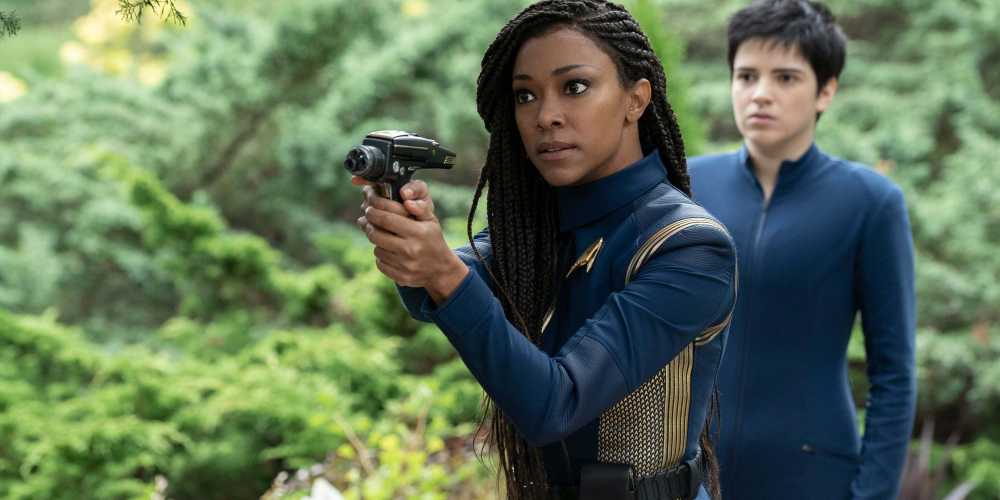
If “The Cage” is a shining example of how Star Trek can seamlessly morph between different casts without shedding its quality, it’s interesting to see how much the franchise hasn’t paid attention to that over the past decade or so.
Star Trek: Discovery certainly bought into the idea, introducing a cast that endeared itself to viewers over the course of five seasons, but it also spent two seasons as a prequel. Other Star Trek shows have taken conflicting routes. Star Trek: Picard and Strange New Worlds dipped back into pre-existing casts, while Star Trek: Prodigy and Lower Decks took the animated path (and adopted vastly different approaches to boot). Starfleet Academy may have assimilated the ensemble nature of classic Star Trek, but being largely stuck in Space Hogwarts has limited the show’s young crew.
What Star Trek franchise needs most in the near-future is simply the ‘next crew.’ The lesson of “The Cage” heeded: that talented new cast + Star Trek format = good television.
Too many recent shows have lacked either the newer characters or the traditional format, and while that’s not necessarily a problem all the time, it’s no substitute for shows in the mold of The Original Series, The Next Generation, and Voyager.
“The Cage” may have secretly provided Star Trek‘s franchise road map from day one, but it feels like the navigation systems need recalibrating ahead of the next era.
