 JuicyTalk
Coinkite the Bitcoin-only hardware wallet manufacturer, recently released the MK5, a significant quality of life and user experience upgrade to the MK4 Coldcard, building on the strong security foundations set by its predecessor. The MK5 comes in many colors and styles. Today, I will review the Orange and Glow in the dark versions, as well as their form factor and user experience upgrades, to answer the question: are the upgrades to the device worth the money?
Building on the well-known and trend-setting MK4 security platform, which brought two secure element chips from different manufacturers and an MCU to the same device. The MK5 focuses instead on quality of life, improving the NFC connectivity, reworking the buttons and plastic chassis of the hardware wallet, as well as adding a much larger screen, among other new features. This is the first hardware upgrade to the Coinkite MK line since the launch of the MK4 in 2022, integrating into it some of the technologies debuted by the Coldcard Q in 2023.
What is new with the MK5 Coldcard?
The big upgrades to the UX are immediately visible; the screen, for one, is much larger, perhaps 30% bigger. Their announcement blog describes it as a “1.54-inch display protected by Gorilla Glass,” which does look and feel much sturdier than older models.
The next obvious upgrade is the buttons. Unlike the MK4 buttons, which are indented, requiring your fingers to go into the socket to get a click, the MK5 buttons are almost at par with the chassis of the device, making them much easier to press. The press feels good, it clicks, giving the user a solid tactile feedback. Much more comfortable than the warm, slightly uncomfortable, unresponsive feel of a touch screen, as seen in other hardware wallets.

You also quickly notice the chassis has been redesigned. The screen section no longer pops out above the keyboard; instead, it’s all one rectangle with comfortable curved edges. It looks more modern, more elegant, while keeping that cypherpunk transparency that shows off the underlying hardware, a signature design principle of Coinkite products.
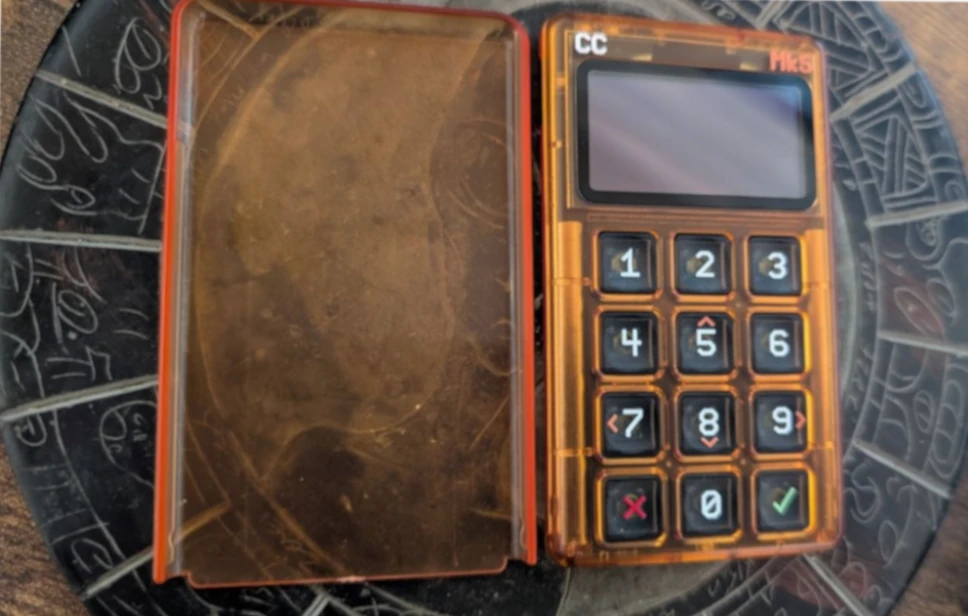
The MK5 also comes with a button and screen protector half case that slides and clicks in and out. It can be entirely removed and fits perfectly from the back of the device, exposing the USB power input at the bottom of the device without issue.
NFC Push Transactions
Last but not least, Coinkite doubles down on NFC support with the MK5. An acronym for near field communication, the NFC antenna is an increasingly popular tech stack in the Bitcoin industry. From NFC tap to pay lightning Bolt cards with cool designs and laser eyes, or Coinkite’s own Tapsigners, to Cashu’s tap to send features developed by Calle.
NFC is a powerful alternative to other wireless connection technologies like Bluetooth or Wifi, which some hardware wallet providers have adopted, but come with some arguable downsides, mainly their range. Unlike the alternatives, NFC is short-range by design; we are talking centimeters in range, whereas Bluetooth and Wi-Fi are talked about in tens of meters. So the paranoid level threat that someone with a long-range antenna pointed at your house might catch a transaction in transit or be able to connect to your device remotely, vanishes.
There’s also no multi-step device connection protocol with NFC; phones either have the feature on and off, the app starts scanning, and transmission can occur. No pin codes, no sifting through lists of Bluetooth-powered devices. Much simpler UX in theory. It is also far superior in terms of user experience to the SD card transmission of pre-signed transactions back and forth from laptops or phones. While NFC may technically cross the ‘airgapped’ line in the MK4 and MK5, NFC still has the best qualities of all wireless connectivity options, and is set to off in the default settings. Similar to the option to connect the MK5 to a computer via USB for data transmission, the NFC antenna can also be severed at a hardware level by scratching off a specific wire within the hardware.
Coinkite’s NFC push Tx software is open source and much smaller in terms of lines of code than Bluetooth or Wifi. The full NFC push Tx code is open source. The client web app side of the protocol has no license defined and is presumably meant to be integrated by any web application. While the hardware side of the code is public, but is limited by the non-commercial use license.
The Colors of the MK5
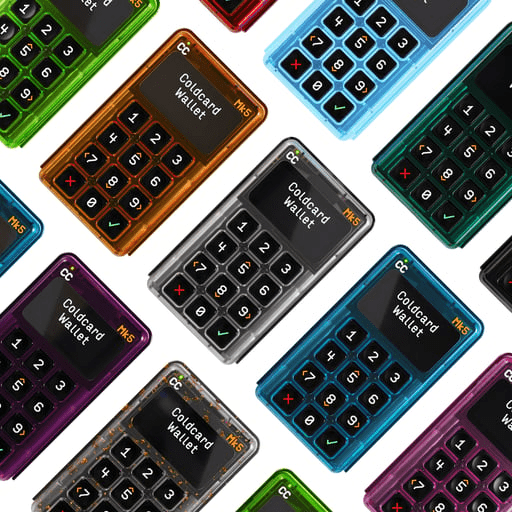
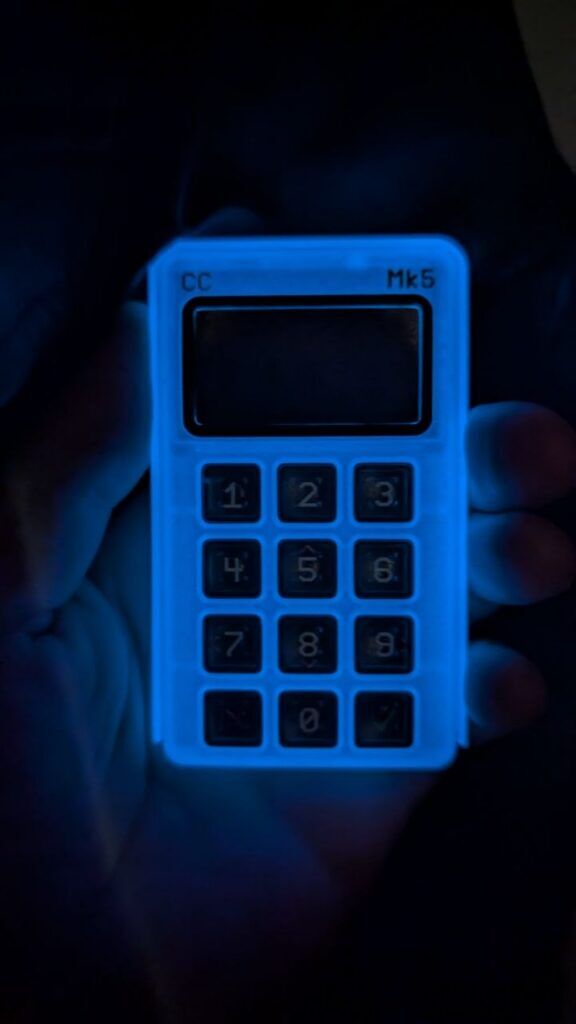
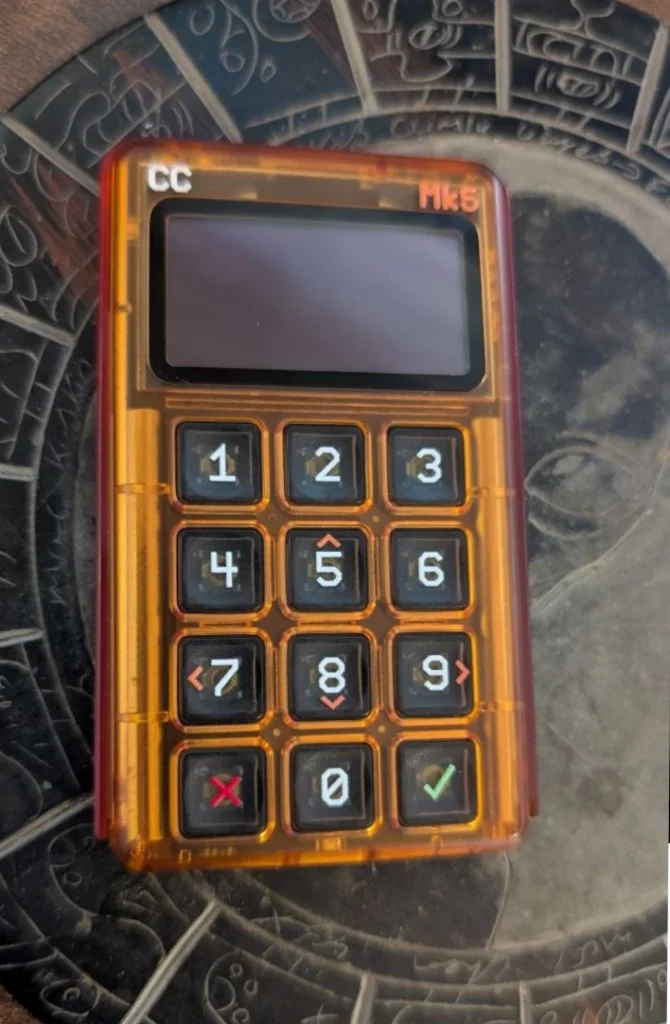
Playing into the Bitcoiner’s hunger for collectibles, the MK5 comes in a wide range of cases, such as gold flaked transparent gray, gorgeous orange and even glow in the dark! I got to play with the Orange and blue glow-in-the-dark version, though I kind of wish I’d gotten my hands on the gold flaked one.
Nevertheless, the designs are beautiful, transparent enough to see the hardware, but colorful enough to be stylish. Here’s what they look like in practice.
Supply Chain Security
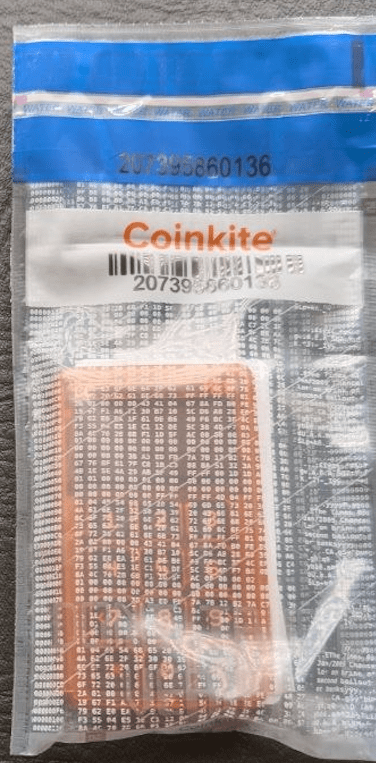
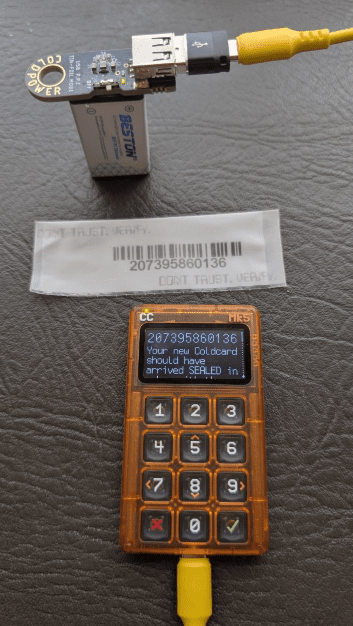
The packaging was also very interesting; the box containing the hardware came with a purchase order of the items, which were inside tamper-proof security bags. These bags had pretty strong plastic, not something you can easily rip, requiring a knife to slice through them. The bags were also marked with a unique number, seen in the pictures below. Inside the bag, another plastic strip contained the same number. And when the devices were first powered on, they displayed the same number on the screen. This is a flash memory code that gets set up per device at the factory. Making interception and manipulation of the firmware of hardware that much more difficult. The next level would be to notify the user of the bag number via email or behind a login on the site, so they can have a side channel to verify the number as well.
If you see anything off with the packaging, you are encouraged to take pictures and reach out to Coinkite support.
The battery and exposed hardware device in the picture below is the COLDPOWER Adapter by Coinkite, which I happened to have laying around and figured I’d test out as well. It is meant to give the device power entirely airgapped, no cables connected to any computer whatsoever, as even a malicious Wifi repeated plugged into a power outlet could transmit signals across the power wires (lol).
Things to improve?
Integration of NFC Push Tx with mobile wallets was a bit inconsistent. I tried Cove, Bull Bitcoin and Nunchuck. Of the three, Nunchuck had the best integration, with Cove not far behind. Bull Bitcoin seems to have disabled the feature or hidden it quite well. Cove is a young project likely to improve leaps and bounds in the coming months, while Nunchuck a very advanced and powerful wallet, took me a few minutes to figure out but ultiumetly turned out to be the best interface of the three.
Even with a stronger NFC antenna, I had to remove my phone’s ridiculously thick case in order to get a reliable data transmission, but that’s not the end of the world.
Conclusion: Is the MK5 worth the money to upgrade?
As a proud owner of what I now realize is an ancient MK3, the move to an MK5 is a significant upgrade, and the low cost of $167 plus shipping, I’d say it is a no-brainer. That’s a whole generation of security and UX upgrades that I did not realize I needed.
For active users of the MK4, the bigger screen and better buttons are definitely an improvement in quality of life, and the better NFC antenna will likely yield dividends as well by making transaction flows smoother. Again, compared to other hardware wallets in the market, the price is very reasonable.
For passive MK4 owners who make a couple of transactions a year, however, the juice might not be worth the squeeze. They are still getting firmware updates and get all the security benefits, and likely won’t miss the improved UX that much.
Disclaimer: Coinkite provided Bitcoin Magazine with a couple of free MK5 Coldcards to use for the purpose of testing their product for review.
