 JuicyTalk
Quick Answer
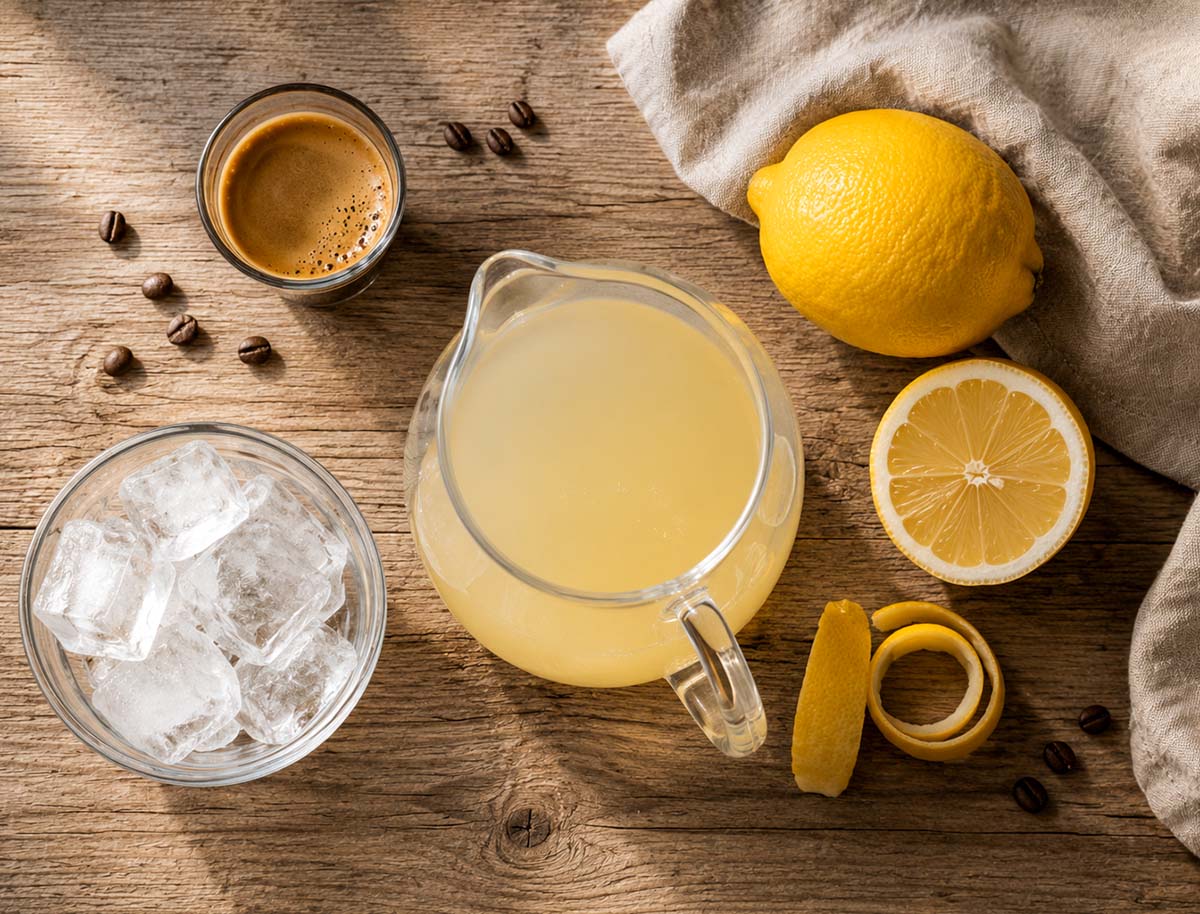
Espresso lemonade is a shot of espresso poured over cold lemonade and ice. Use a 1:4 ratio, one 1.5 oz shot of cooled espresso to 6 oz of tart, not too sweet lemonade, over big ice cubes. The citric acid shortens the perception of coffee’s bitterness while the coffee cuts the lemonade’s sugar, so neither ingredient dominates. It takes about three minutes and contains roughly 90 to 95 mg of caffeine.
Espresso Lemonade At a Glance
| Also known as | Arnold Espresso, coffee lemonade, mazagran |
| Origin | Algeria, 1840; preserved in Portugal, Austria, Catalonia |
| Core ratio | 1:4 espresso to lemonade |
| Standard build | 1.5 oz cooled espresso + 6 oz tart lemonade + large ice |
| Time | 3 minutes |
| Caffeine | Approximately 90 to 95 mg (120 to 150 mg with a full double shot) |
| Best coffee | Light to medium roast, Ethiopian or Kenyan |
| Best substitute | Cold brew concentrate, 2 to 3 tbsp |
TikTok found espresso lemonade this summer and reacted the way the internet always reacts, with a mix of delight and moral panic. A Detroit shop posted a video of a customer ordering a shot of espresso in lemonade, a barista said she was terrified, and the comment section turned into a referendum on whether this was genius or a war crime against coffee.
Here is the thing almost every write up has glossed over. This drink is not new. It is not two years old, or ten. It has been served continuously somewhere in the world since roughly 1840, and the people drinking it in Lisbon right now would be baffled to learn it needed inventing.
What follows is the version of this story with the gaps filled in, where the drink actually came from, why the flavor chemistry works, the exact ratios that hold up, and honest answers to the questions people are typing into search bars at 2 a.m.
What Is Espresso Lemonade?
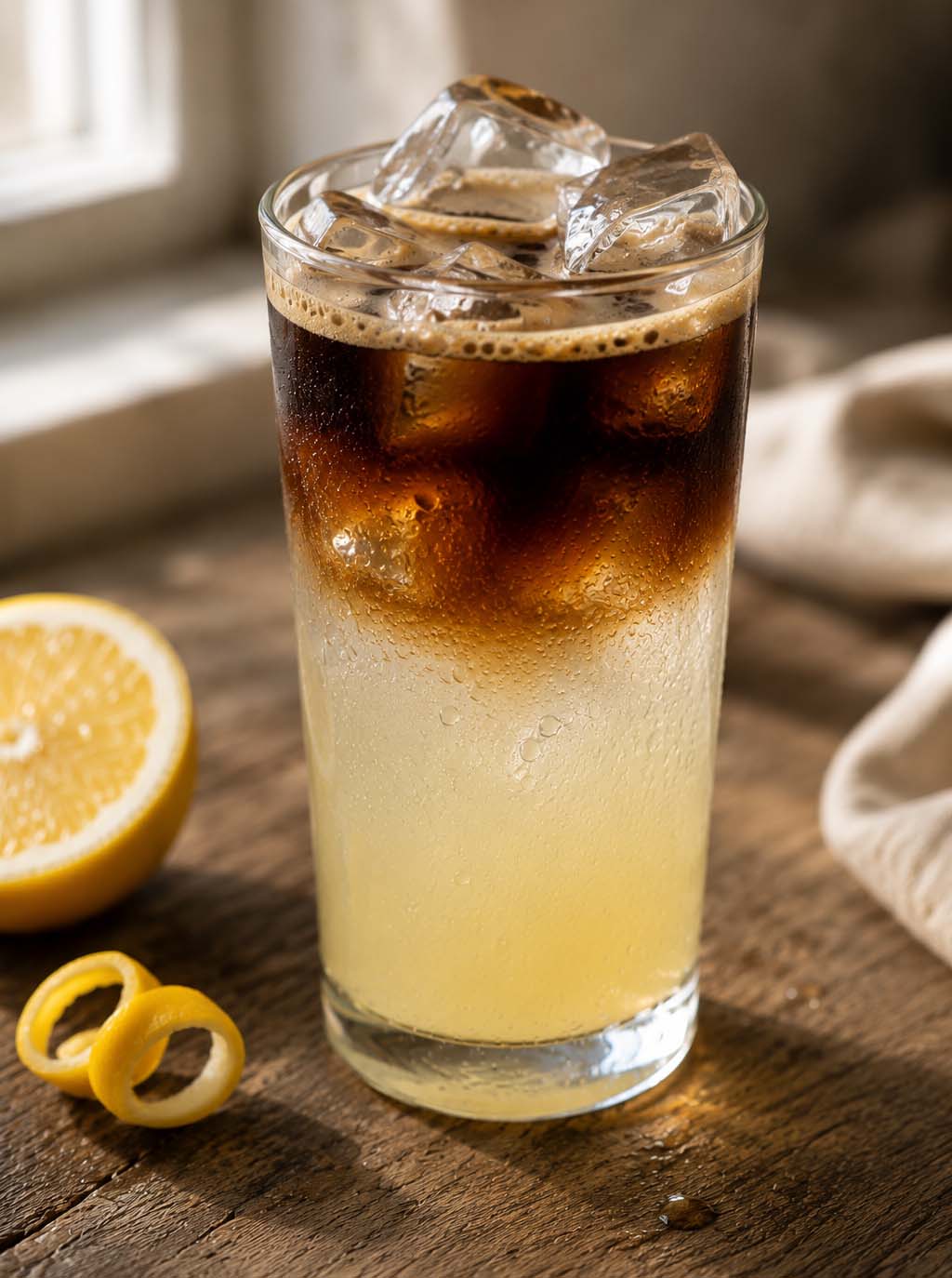
Espresso lemonade is a cold coffee drink made by pouring a shot of espresso over sweetened lemonade and ice. The espresso floats briefly in a dark layer over the pale lemonade before it is stirred, which is most of the reason it films so well.
At its simplest it is two ingredients. Common additions are sparkling water for lift, a lemon wheel or twist for aroma, and fresh mint. The drink is served cold, over ice, in a tall glass.
It goes by several names depending on who is serving it: Arnold Espresso (a riff on the Arnold Palmer, coined by the Detroit shop whose video started the current wave), espresso lemonade, coffee lemonade, and, historically and correctly, mazagran.
The History Nobody Is Telling You
The current trend is a rediscovery, not an invention, and the real story is considerably more complicated than a TikTok caption allows.
The drink traces to 1840, in Algeria, under French colonial occupation. French troops garrisoned at a fortress called Mazagran, near the coastal town of Mostaganem, needed coffee they could drink in North African heat. They cut it with cold water, sometimes sweetened it with coffee syrup, and sometimes added cognac or rum to stay alert on night patrols. The fortress gave the drink its name. That name carries weight: Mazagran was the site of a battle in the French invasion of Algeria, a colonial occupation that did not end until 1962.
Mazagran has been called the original iced coffee. It predates most of what we would recognize as the category.
Where it survived: ordering a mazagran in France was still common into the twentieth century and has largely faded there. The strongest surviving tradition is in Portugal, where mazagran evolved into something very close to what TikTok is drinking now, espresso over ice with lemon, sometimes lemonade, often a measure of rum, sometimes mint. In Austria it is served with an ice cube and rum or maraschino, drunk in a single go. In Catalonia, iced coffee with lemon is standard.
So when a TikTok commenter points out that this is just mazagran, they are right. The Detroit customer independently arrived at a drink that has been on Portuguese cafe menus for over a century.
Why Espresso and Lemonade Actually Work Together
Most coverage stops at “surprisingly, it works.” Here is the mechanism.
- Acid shortens bitterness. Coffee’s bitterness comes largely from compounds developed during roasting. Citric acid does not neutralize those compounds, but it changes how they bind to taste receptors, so the bitterness resolves faster instead of lingering.
- Coffee cuts sweetness. This runs the other direction, and it is why the drink is not cloying. Espresso’s bitterness offsets the sugar in most commercial lemonade, which is why testers consistently report the result tasting less sweet than the lemonade did on its own.
- Acid increases aroma release. Lowering the surface pH changes how volatile aromatic molecules leave the liquid, so more aroma reaches your nose. This is the same reason a squeeze of lemon makes almost any dish taste more like itself.
- They are already neighbors. Coffee is a naturally acidic beverage, around pH 4.5, and good light roast coffee is often described with citric, bright, tart tasting notes. Adding lemon is amplifying a flavor that is already there.
Espresso with citrus already has a name, the espresso romano, and its history is more contested than most articles let on. It is often sold as an old Italian custom, but ask an actual barista in Rome and you will get a puzzled look. Coffee historians trace it either to postwar Campania, where it survives today as caffe al limone, possibly born from masking the flavor of poor wartime beans, or to Italian American cafes that gave an invented drink an Italian sounding name. Illy’s own site lists lemon in espresso as a myth. Whichever story is true, it confirms this is not the first time someone paired coffee with citrus and liked the result. If you want to go deeper on what roast level does to flavor, our piece on how to spice up your coffee and boost brain health and our guide to coffee alternatives are worth a look.
The Better Living Espresso Lemonade Recipe
The Ratio, and How to Adjust It
Start at 1:4, one part espresso to four parts lemonade. This is the ratio that holds up across the widest range of lemonades and roast levels.
| If it tastes… | Do this |
|---|---|
| Too bitter or coffee forward | Increase lemonade to 8 oz (1:5) |
| Too sweet or flat | Add a half shot of espresso (1:3) |
| Too heavy | Top with 2 oz sparkling water |
| Sour and thin | Add a bar spoon of simple syrup |
| Watery | Your espresso was hot, or your ice too small |
Ingredient Notes That Actually Change the Outcome
Lemonade: the failure mode here is not tartness, it is sugar water. Avoid anything that tastes like lemon flavored syrup. Look for tart, cloudy, refrigerated lemonade, or make your own.
Coffee roast: light and medium roasts work better than dark. Fruity, bright coffees, Ethiopian and Kenyan beans especially, share flavor compounds with citrus. See our note on why we’re drawn to bitter flavors for more on that contrast.
Espresso alternative: no machine is not a problem. Cold brew concentrate is arguably better, less acidic, more forgiving of ratio errors, already cold. Use 2 to 3 tablespoons in place of the shot. Check that your beans are still good with our guide on whether coffee goes bad and how to store it. Don’t toss the used grounds either, there are good ways to reuse coffee grounds around the house.
Six Variations Worth Making
1. The Portuguese Mazagran (the original). Espresso over ice, a generous squeeze of fresh lemon, simple syrup to taste, a sprig of mint, and 0.5 oz of aged rum. This is the drink as it is actually served in Lisbon and it is better than the TikTok version.
2. Espresso Lemonade Spritz. Cut the lemonade to 4 oz and top with 4 oz of sparkling water or club soda. Lighter, longer, and the carbonation carries aroma.
3. Rosemary Espresso Lemonade. Slap a rosemary sprig between your palms to release the oils and drop it in. The resinous note against coffee and citrus is unexpectedly excellent.
4. Espresso Lemonade Tonic. Replace the sparkling water with tonic. The quinine adds its own bitterness that plays well with a fruity light roast. Build with mint, then tonic, then lemonade, then espresso, pouring each slowly.
5. The Arnold Espresso Palmer. 3 oz lemonade, 3 oz unsweetened iced black tea, 1.5 oz espresso. The tea’s tannins bridge the coffee and citrus. Pairs well with our cold brewed peach mint iced tea if you want a tea forward pitcher on hand too.
6. Batch pitcher (serves 6). Combine 9 oz cooled espresso or cold brew concentrate with 36 oz chilled lemonade in a pitcher. Refrigerate up to 24 hours. Pour over fresh ice to serve. Do not add ice to the pitcher, it will be watery by the second glass. More on building a full drink menu in our summer entertaining tips, and our manuka honey lavender lemonade makes a good alcohol free option alongside it.
Two Spirited Versions
Vodka (1.5 oz): adds nothing but proof, which is the point. The coffee and citrus stay crisp and unobstructed.
Bourbon (1.5 oz): caramel and vanilla notes bridge the espresso beautifully. The better of the two if you want the drink to taste like something.
Aged rum (0.75 oz): the historically correct choice, used in both Portuguese and Austrian mazagran. If cocktail hour coffee is your thing, our healthy hot toddy and Buenavista Irish coffee are worth bookmarking too.
Honest Answers to the Questions People Are Actually Asking
Does espresso lemonade curdle?
No. This is the most common worry and it is unfounded, curdling requires dairy protein, and there is none in this drink. If you want to add milk or a splash of cream, that is where the acid becomes a problem, lemon juice will curdle milk on contact. Add oat milk or dairy to lemonade at your own risk.
See also

Is it bad for acid reflux?
For people with GERD or reflux, this drink stacks the deck against you. Coffee and citrus are both common triggers, and both can relax the lower esophageal sphincter. Adding carbonation makes it worse by increasing stomach pressure. If you are reflux prone and want to try it, use cold brew, skip the sparkling water, and do not drink it on an empty stomach. Triggers are individual, so pay attention to your own response, and talk to a doctor if reflux is a persistent problem.
Will it hurt my teeth?
Any beverage below about pH 5.5 softens enamel, and lemonade sits around pH 2 to 3. The risk is less about drinking it and more about how, sipping slowly over an hour keeps your teeth bathed in acid the entire time. Drink it in a reasonable window, use a straw, and rinse with plain water afterward. Do not brush immediately, softened enamel brushes away, wait about thirty minutes. More in our guide on how to eat for healthy teeth.
How much caffeine is in it?
A single 1 oz shot of espresso contains about 63 mg of caffeine by USDA reference data, so the 1.5 oz pour used here lands around 90 to 95 mg. If you pull a full 2 oz double shot instead, expect closer to 120 to 150 mg. Either way, that is less than a 12 oz drip coffee (about 140 mg) and well under a grande cold brew (about 205 mg). Made with 3 tablespoons of cold brew concentrate, expect somewhat more, closer to 100 to 120 mg depending on the brand.
Can I make it decaf?
Yes, and it works fine. The flavor mechanism here is roast bitterness against acid, which decaf espresso still has. Good option for the evening.
Is it healthier than an iced latte?
Different, not clearly better. It has no dairy and is lighter on the palate, but a standard 6 oz pour of commercial lemonade runs roughly 75 to 100 calories and 20 to 30 grams of sugar, comparable to or more than a sweetened latte. The espresso itself adds almost nothing, just a few calories. To cut the sugar, make lemonade with half the usual sugar, or use fresh lemon juice, water, and a small amount of honey, the espresso will make it read as sweeter than it is.
Hot espresso or cold?
Cold or room temperature, always. Hot espresso melts your ice, and dilution is the primary way this drink fails.
Can I use regular coffee instead?
Only if it is strong. Standard drip is too weak. Cold brew concentrate is the best substitute and is more forgiving than espresso.
Can I make it ahead?
Yes. The espresso lemonade mixture keeps in the refrigerator for 24 hours. Add ice only at serving.
Should You Actually Make This?
Yes, with a caveat about when. This is not a replacement for a morning coffee, and it is not a cold weather drink. What it is: the best answer to a specific and common problem, wanting caffeine at 3 p.m. in August when the thought of anything creamy is unappealing. In that narrow slot it is close to unbeatable, bright, cold, not heavy, delivering the caffeine without the weight of an iced latte.
And when someone tells you it is a TikTok invention, you now know better. It has been getting people through hot afternoons since 1840. The internet just got around to noticing.


