JuicyTalk
The Twilight Zone episode 6, “Six Degrees of Freedom”, uses a space mission premise to raise larger questions about the cosmos, and like most episodes of the show, the ending of the “Six Degrees of Freedom” Twilight Zone installment created many conversations. As Earth destroys itself, five astronauts attempt to successfully land on Mars in order to colonize the planet.
At times, “Six Degrees of Freedom” feels like a bait-and-switch episode, but it ultimately reaches a profound conclusion about salvation and what’s known as “The Great Filter.” “Six Degrees of Freedom” stars DeWanda Wise, Jessica Williams, Jonathan Whitesell, Lucinda Dryzek, and Jefferson White. For most of The Twilight Zone episode, the crew members bond while affirming their mission’s beliefs and reflecting upon the past.
Two people are caught having sex, which leads Wise’s Alexa Brandt to face some existential questions; however, the priority is indeed maintaining order. By the time the “Six Degrees of Freedom” Twilight Zone ending arrives, the astronauts come face-to-face with the Great Unknown, and they must choose to believe in a higher power, even if it negates the facts proposed by one of their own.
The Twilight Zone “Six Degrees Of Freedom” Ending Explained
The Twilight Zone “Six Degrees of Freedom” ending is the culmination of one of the most cerebral episodes in the 2019 reboot of the classic sci-fi anthology series. The inciting incident in The Twilight Zone‘s “Six Degrees of Freedom” transpires during a birthday party. As the crew dances to “California Dreamin’,” Jerry (Jefferson White) reveals that he’s been collecting data samples for 105 days, and he believes the Bradbury Heavy mission is actually some type of simulation.
“None of this is real,” he says, “It’s just a test.” Naturally, Jerry’s fellow astronauts are caught off guard by the theory, and they panic as warning sounds drown out their collective voices. Jerry hopes to prove his theory by opening a shuttle gasket while whispering “six degrees of freedom.” Jerry sees nothing but fire, and his apparent death transitions to a morose “California Dreamin’” montage.
“Six Degrees of Freedom” ends by revealing that Jerry didn’t die “for nothing.” In fact, he’s about to be reunited with his crew members, but not necessarily in the afterlife. Extraterrestrials transported Jerry to their home base, wherever that may be, upon realizing that he was cognizant of some type of test, which turns out to be an experiment to determine whether the human race is worthy of salvation, something possibly influenced by the iconic sci-fi film, The Day The Earth Stood Still. The aliens decide that, yes, humans are worth saving, even if they manage to destroy planet Earth.
What The “Six Degrees Of Freedom” Twilight Zone Ending Means

As with all episodes of the show, the “Six Degrees of Freedom” Twilight Zone ending explained some complex philosophical ideas beneath the gripping sci-fi narrative. Jerry’s paranoia and ego parallel real-life problems, though the character’s intentions don’t seem to be malicious or purely self-serving. The problem, however, is that Jerry puts everyone else in jeopardy.
By the point of Jerry’s death, “Six Degrees of Freedom” emphasizes the crew’s distrust of one another, along with their camaraderie while pursuing a shared goal. Through Jerry’s character arc, “Six Degrees of Freedom” allows for a side commentary on communication and data processing. The astronauts renew their bond and receive confirmation that Jerry was, in fact, wrong about his simulation theory, evidenced by crystallization data.
With the mission moving forward, and thus the human race, the Twilight Zone episode uses nostalgic character dialogue to once again tease that “Six Degrees of Freedom” is actually about simulation testing, all the while using The Interrupters’ 2014 song “Family” to underline the crew’s state of mind.
And so, the astronauts land safely on Mars and realize that they have made it through The Great Filter. As a whole, “Six Degrees of Freedom” addresses themes of salvation, existentialism, and the Platonic concept that humans have a natural desire to find their other half, even if it means crossing over through The Great Filter.
How Six Degrees Of Freedom Was Received
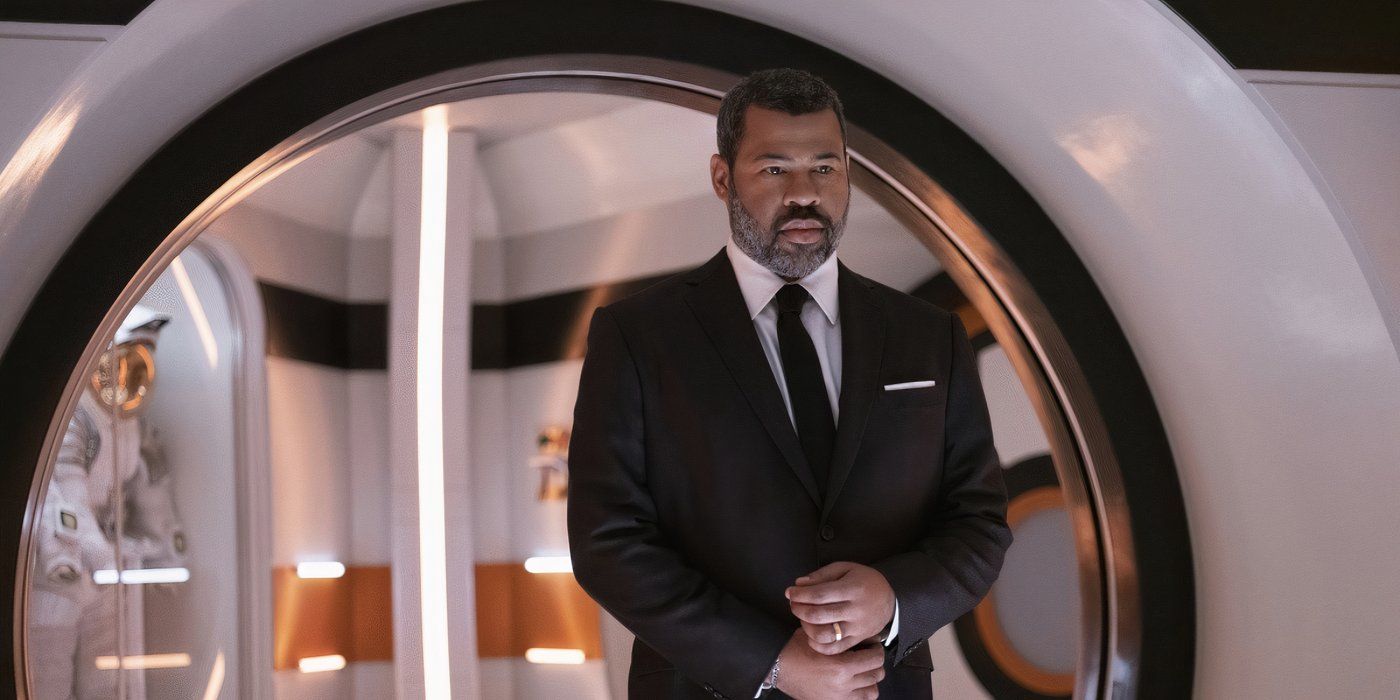
Overall, the 2019 reboot of The Twilight Zone was seen as an ambitious attempt to breathe new life into the classic sci-fi anthology franchise, though it failed to live up to the legacy of the original. This general sentiment extends to “Six Degrees Of Freedom”, with everything that occurred from the start to the end of the Twilight Zone reboot episode being seen as an admirable attempt at a philosophically deep story, but one that didn’t quite hit the mark. The “Six Degrees of Freedom” Twilight Zone ending fed into this, with the reveal that it had all been part of a test seen as predictable by some viewers.
However, the 6th episode of the reboot did receive praise compared to the five that preceded it for a few interesting reasons. “Six Degrees Of Freedom” was pointed out by many critics as one of the freshest feeling stories of the Twilight Zone reboot episodes because it didn’t rely on social commentary, an interesting take, given that mixing social commentary with science-fiction was generally where many of the best moments of the series came from in every iteration.
Of course, given the space-faring nature of “Six Degrees Of Freedom”, the set design and costuming were also singled out as particularly exemplary for a small-screen outing, and it’s definitely one of the best looking Twilight Zone reboot episodes in the two seasons of the series’ latest run. The fact that “Six Degrees Of Freedom” is still quite widely discussed in the fandom does stand as a testimony to its impact, and why it’s not the pinnacle of The Twilight Zone, it is far, far from being the worst episode.

- Release Date
-
1959 – 1964-00-00
- Showrunner
-
Rod Serling
- Directors
-
John Brahm, Buzz Kulik, Douglas Heyes, Lamont Johnson, Richard L. Bare, James Sheldon, Richard Donner, Don Medford, Montgomery Pittman, Abner Biberman, Alan Crosland, Jr., Alvin Ganzer, Elliot Silverstein, Jack Smight, Joseph M. Newman, Ted Post, William Claxton, Jus Addiss, Mitchell Leisen, Perry Lafferty, Robert Florey, Robert Parrish, Ron Winston, Stuart Rosenberg
- Writers
-
Charles Beaumont, Richard Matheson, Earl Hamner, Jr., George Clayton Johnson, Jerry Sohl, Henry Slesar, Martin Goldsmith, Anthony Wilson, Bernard C. Schoenfeld, Bill Idelson, E. Jack Neuman, Jerome Bixby, Jerry McNeely, John Collier, John Furia, Jr., John Tomerlin, Lucille Fletcher, Ray Bradbury, Reginald Rose, Sam Rolfe, Adele T. Strassfield