 JuicyTalk
It’s been almost thirty-six years since 1990’s iconic Spider-Man #1 hit shelves and became a part of comic history. The issue sold more comics than anyone had known was possible, encapsulating an era where comics were more popular and profitable than ever before.
The series was intended as a vehicle for superstar artist Todd McFarlane, who would go on to change the face of the comic industry forever. McFarlane wrote and drew the issue, with colors from Bob Sharen and letters by Rick Parker.
But more than three decades since it made history, is Spider-Man #1 still worth your time? That’s what I aim to find out in this retro-review.
1990’s Spider-Man #1 wasn’t the first Spider-Man comic, but rather the first in a new volume. Spider-Man first got his own solo series in 1962’s Amazing Spider-Man #1.
How Successful Was 1990’s Spider-Man #1?

Look up Spider-Man #1‘s success and you’ll see multiple reports that it sold over 2.5 million copies. I haven’t been able to verify that, though the important details – that it was the best-selling single-issue comic of all time when released – seem true.
The issue is that while we have good records of how many issues Marvel sold to retailers, we don’t have the same kind of reliable information on how many of those issues were actually bought by readers.
Comichron, the gold standard for comic sales metrics, seemingly accounts for 2,250,000 comics sold to retailers. Meanwhile, Steve Saffel’s authoritative Spider-Man the Icon: The Life and Times of a Pop Culture Phenomenon puts the number at 2,350,000, with an additional 500,000 then printed to meet unexpected demand.
Ultimately, the maximum total doesn’t matter. Even just one million copies would have been enough to set a world record by some distance, and I’m confident calling 1990’s Spider-Man #1 the best-selling Spider-Man comic of all time, and the best-selling single-issue comic of all time when it was released.
Sadly, Spider-Man #1 only held its crown as the best-selling single issue of all time for one year. 1991’s X-Men #1 still holds the record today, selling over eight million copies.
What Made Spider-Man #1 So Successful?

In comics, the late eighties to early nineties are now known as the Comic Speculator Bubble. At the time, classic comics from the 30-50s were being sold for incredible amounts. The characters they introduced had become icons, and the original comics were now rare, originally intended as disposable and made from pulpy, low-quality paper.
Comic fans begin to think of modern comics as potential investments, and the market changed to serve that, playing up the idea of collector’s editions. Spider-Man #1 was sold in various editions, including ‘bagged’ editions intended to be kept in mint conditio and never read.

At the same time, Todd McFarlane was a blockbuster artist, with a level of popularity that’s hard to imagine in today’s market. Marvel giving him Spider-Man to write and draw (and without an adjective, suggesting it was the definitive comic starring the character) was always going to attract fans.
So the right creator was there at the right moment with the right character. Was Spider-Man #1‘s success an anomaly, or does it still deserve the hype? That’s what we’re here to figure out.
Spider-Man #1 Retrospective Review: The Plot

Reading Spider-Man #1, I was shocked at the lack of ground it covers in its first issue. The comic opens with Spider-Man stopping a mugging, returning home to flirt with Mary Jane, then heading out on patrol the next morning.
Meanwhile, a hidden character (later revealed as Kraven ally/rival Calypso) drives classic villain the Lizard into a feeding frenzy. The reptilian killer stalks New York’s streets, gorily claiming a few victims (or at least, as gorily as Marvel would allow in the ’90s – a major bone of contention for McFarlane at the time.) The issue ends by implying that Spidey and the Lizard are on a collision course.

Yes, Spider-Man #1 ends without Spider-Man actually confronting a supervillain, but that’s not necessarily a bad thing. As the first issue of a new volume, it’s to be expected that the comic needs to lay out its characters and status quo, building the Lizard up as a worthy first threat for a new era.
Spider-Man #1 Retrospective Review: The Writing

In terms of the writing, Spider-Man #1 dabbles in melodrama – not exactly unfamiliar in superhero media. The first time Spider-Man appears, the narration boasts, “His name — SPIDER-MAN! His powers — EXTRAORDINARY! His webline — ADVANTAGEOUS!”

Elsewhere, McFarlane adopts a Noir-ish tone, pushed to a tongue-in-cheek extreme. The opening pages introduce New York as a big, bad city teeming with crime, “littered with towering concrete giants that seem to swallow up the sky.” The city’s residents are described as scurrying three different times – likely, but not definitely, as a deliberate gag.

Somewhat confusingly, the issue uses two (technically three) sources of narration – a nameless omniscient narrator and also Peter Parker, alongside a single page of Calypso reflecting on her plan. Narration is out of style in modern comics, and it does feel intrusive in this issue, especially because McFarlane’s voice does so much to characterize what readers are seeing.
Despite that fact, there are high points in the writing. Peter boasting that regular muggers are fools to fight him acts as grim dramatic irony, given what fans know is heading his way, and there’s a smart above/below contrast suggested between hero and villain.

McFarlane also refers to Spidey as “this hero of youth” – a characterization I’d never really considered before, but one that suits the character, especially in this issue. The city he lives in might be grim, but Peter Parker isn’t.
Spider-Man #1 Retrospective Review: The Art

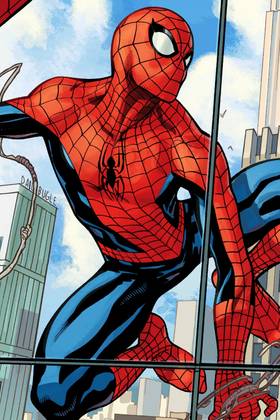
Spider-Man #1 is undoubtedly a showcase for McFarlane’s art, with both Spider-Man and the Lizard showcasing his dynamic posing and almost unbelievable level of detail.

The Lizard is a feral monster, drooling and splashing blood, while Spidey’s webs alone must represent hours of work. While McFarlane isn’t a master of composition, he knows how to showcase his best work, and small details like Spider-Man breaking the comic panel give him undeniable presence.
Sadly, McFarlane’s art falls down when he’s depicting mere humans. McFarlane’s faces come off as caricaturish, with exagerrated features, flat faces and peculiar mouths.

To me, these aren’t characters to take seriously or care about, but rather for the Lizard to terrorize or Spider-Man to swing above. There’s a sense of dismissiveness in both the art and writing for anyone but the main characters. When Spider-Man saves an innocent woman from a mugger, criminal and victim come off equally cartoonish and silly – they’re both kind of wasting his time.
McFarlane’s Art Turned Him into One of the Most Influential Comic Creators of All Time

I’ve never been a particular fan of Todd McFarlane’s art, but it’s worth noting that a huge amount of people are. Shortly after Spider-Man #1, McFarlane left Marvel to found Image Comics with a group of other hotshot artists.

His first project there was Spawn – a legendary title which likewise set sales records in the sphere of indie comic books. Spawn is an undeniable success – now the longest running creator-owned comic in history (according to Guinness World Records), and still setting sales records today.
In 2022, Image claimed that sales of The Scorched made it the biggest new team book of the past 30 years, including Marvel big-hitters like X-Men and Guardians of the Galaxy. Spider-Man #1 was a huge moment for McFarlane, but just one in an immensely successful career.
Is Spider-Man #1 Still Worth Checking Out?

Sadly, no. If Todd McFarlane’s art is your thing then there are some all-time great pictures of Spider-Man in this comic, and the Lizard has arguably never been such an imposing presence.
However, there’s nothing else here worthy of the comic’s record-setting popularity. The story teases an imposing clash but doesn’t contain one, and Peter Parker comes off as vaguely obnoxious, lacking his characteristic concern for others.

Meanwhile, the narration encourages readers not to take anything seriously without actually delivering enjoyable comedy. There’s an overriding sense of ‘business as usual’, and no real stakes. Sure, the Lizard kills a few people, but mostly just as a showcase of his teeth and claws.

Some pages are skillfully composed, while others appear haphazard, like McFarlane was rushing to get to the good part. Frequently, characters appear rubbery or deformed, drawn to just about fit into their comic panel or with misshapen eyes.

Sadly, despite its place in history, there’s little about Spider-Man #1 that should tempt fans to revisit it today.
Fans of 90s Comic Should Revisit X-Men #1 Instead

Our retro reviews of the best-selling comics ever began with Chris Claremont and Jim Lee’s X-Men #1, and there’s simply no comparison between that comic and its contemporary Spider-Man #1.
That issue introduces a whole team of distinct characters and takes Magneto from retirement to renewed wrath without feeling either spare of crowded. Art is still the focal point of the issue, but in a seamless way that puts Spider-Man #1‘s disjointed gallery of cool Spidey poses to shame.

Ultimately, Spider-Man #1 covers precious little ground. The issue is ultimately all style, very little substance, and that style isn’t spread evenly, but rather concentrated on a few admittedly excellent images that make the most of McFarlane’s skillset.
If you love the Wall-Crawler, 1990’s Spider-Man #1 is worth reading for its place in industry history, but otherwise your time is better spent elsewhere.
- First Appearance
-
Amazing Fantasy
- Alias
-
Peter Parker, Ben Reilly, Otto Octavius, Yu Komori, Kaine Parker, Pavitr Prabhakar, William Braddock, Miles Morales, Kurt Wagner
- Alliance
-
Avengers, Fantastic Four, X-Men, Secret Defenders, Future Foundation, Heroes for Hire, Mighty Avengers, New Avengers, Web-Warriors
- Race
-
Human


