 JuicyTalk
Summary
- Adaptations continually find new audiences via bold remakes and streaming releases.
- Top films blend horror, drama and coming-of-age heart rather than pure jump scares.
- Modern filmmakers reimagine short tales into feature films without losing emotional core.
Stephen King has been supplying Hollywood with material for half a century, yet filmmakers are nowhere near finished with him. His stories keep finding new audiences, whether through fresh adaptations or renewed interest in older hits. ScreenRant’s coverage of movies like It shows just how much appetite remains for the particular brand of coming-of-age horror King helped define.
The timing is especially good for another look at King’s movies. The Boogeyman, Rob Savage’s 2023 adaptation of King’s short story, arrives on Netflix today, Oct. 5. Two days later, Mike Flanagan returns to King’s work with his new Carrie series on Prime Video.
For this ranking, “the last 25 years” means movies released from 2001 onward. That removes untouchable older adaptations like Misery, The Shawshank Redemption, and The Green Mile from contention, which makes the competition considerably more interesting.
King may be synonymous with horror, but the best films based on his work have never fit neatly into one box. Several of the movies below are frightening, while others find their power somewhere entirely different. Together, these 10 show just how productive the last quarter-century has been for Stephen King on the big screen.
10
The Boogeyman (2023)
The Boogeyman earns the No. 10 spot by turning a very short piece of King fiction into a feature-length story without losing the simple fear that made the original work. Sophie Thatcher stars as Sadie Harper, whose grieving family becomes prey for an entity hiding in the darkness of their home.
Rob Savage leans into the childhood terror of what might be waiting in a dark bedroom. The movie is less ambitious than several adaptations higher on this list, but Thatcher gives it emotional weight, and its creature works best when Savage resists showing too much. Its Netflix arrival makes now an ideal time to give it another look.
9
The Monkey (2025)
Osgood Perkins went in an entirely different direction with The Monkey. Based on King’s 1980 short story, the movie follows twin brothers Hal and Bill, both played as adults by Theo James, whose childhood discovery of a sinister toy monkey leads to an increasingly absurd series of deaths.
Perkins treats death with a vicious sense of humor rather than the solemnity associated with many King adaptations. That tonal gamble gives The Monkey an identity of its own. Beneath the elaborate kills is something recognizably King: childhood damage does not conveniently disappear when the people carrying it grow up.
8
1922 (2017)

Thomas Jane has appeared in several King adaptations, but 1922 gives him one of his best roles. He plays Nebraska farmer Wilfred James, who convinces his teenage son to help murder his wife after she announces plans to sell their land. What follows is less a mystery than a long, miserable reckoning.
Zak Hilditch lets guilt infect practically every frame. Rats become an increasingly grotesque presence, but Wilfred’s deterioration is more disturbing than anything supernatural the movie can offer. 1922 remains strangely overlooked considering how successfully it captures the grim fatalism of King’s novella.
7
The Life Of Chuck (2025)

The Life of Chuck is useful evidence whenever somebody reduces Stephen King to a horror writer. Mike Flanagan’s adaptation moves backward through the life of Charles Krantz, beginning with what appears to be the end of the world before gradually revealing why this seemingly ordinary man matters.
Its reversed structure turns an apocalyptic mystery into something unexpectedly warm. Our breakdown of The Life of Chuck’s opening act gets into its stranger mechanics, but the movie works because Flanagan understands King’s affection for ordinary people as well as he understands the author’s monsters.
6
1408 (2007)

Few horror premises are cleaner than 1408. John Cusack plays Mike Enslin, a cynical writer who investigates supposedly haunted locations and checks into the Dolphin Hotel’s forbidden room despite repeated warnings from manager Gerald Olin, played by Samuel L. Jackson. Mike expects another fraud. Room 1408 has other plans.
The movie traps viewers alongside Mike and continually changes the rules of his imprisonment. Director Mikael Håfström relies more on psychological horror than gore, allowing Cusack to carry long stretches nearly alone. Almost 20 years later, 1408 remains effective because the room never needs a tidy explanation to be terrifying.
5
Doctor Sleep (2019)

Following The Shining would be intimidating under any circumstances. Mike Flanagan faced an even stranger challenge with Doctor Sleep: adapt King’s literary sequel while acknowledging Stanley Kubrick’s famous movie, which diverged considerably from the original novel.
Somehow, the compromise works. Ewan McGregor’s adult Dan Torrance feels shaped by the Overlook without existing solely for nostalgia, while Rebecca Ferguson makes Rose the Hat a magnetic antagonist. Flanagan eventually returns to familiar territory, but Doctor Sleep earns that homecoming by giving Dan a compelling story of his own.
Flanagan’s relationship with the author has only grown since, with his new adaptation of Carrie continuing one of the most successful modern filmmaker-author partnerships.
4
Gerald’s Game (2017)

For years, Gerald’s Game seemed practically impossible to adapt. Much of King’s novel takes place inside Jessie Burlingame’s head as she lies handcuffed to a bed after her husband suddenly dies. Mike Flanagan found a cinematic solution without sacrificing the claustrophobia that makes the story so uncomfortable.
Carla Gugino gives one of the finest performances in any modern King adaptation. Jessie’s memories begin colliding with her increasingly desperate present, turning physical entrapment into something much deeper. The notorious escape sequence may be the movie’s hardest moment to watch, but the confrontation with Jessie’s buried trauma is what gives it staying power.
3
The Long Walk (2025)

Stephen King wrote The Long Walk before he published Carrie, but the dystopian novel waited decades for a movie adaptation. Francis Lawrence finally brought it to the screen in 2025, with Cooper Hoffman and David Jonsson leading a group of young men forced to keep walking in a lethal government competition.
The simplicity of the premise becomes its greatest strength. There is nowhere for the characters to hide, and every mile strips away more of whatever confidence they began with. The relationships between the walkers prevent the movie from becoming a mechanical exercise in suffering.
The adaptation continued finding viewers long after leaving theaters, with The Long Walk later climbing the Prime Video charts. Its success feels particularly satisfying considering how long King’s story resisted making the jump to film.
2
It (2017)
Pennywise already had a famous screen incarnation before Andy Muschietti’s It, making Bill Skarsgård’s task considerably harder. Rather than imitate Tim Curry, Skarsgård created a stranger and more physically unnerving clown, while the young cast made the Losers’ Club the real reason audiences became invested.
The movie became an enormous commercial hit, but box office alone does not earn it the No. 2 position. It understands the coming-of-age story underneath King’s horror. Pennywise can become almost anything because every child fears something different, yet the bond between the Losers gives the movie its heart.
Interest in the original novel remains enormous four decades after publication, with a 40th-anniversary edition featuring an introduction from the Duffer Brothers arriving in 2026. Muschietti’s adaptation played a major role in introducing Derry to a new generation.
1
The Mist (2007)

Frank Darabont had already directed two extraordinary Stephen King adaptations before The Mist, but his third may be the one that leaves the deepest scar. Thomas Jane stars as David Drayton, who becomes trapped inside a supermarket with his son after an unnatural fog brings deadly creatures into town.
The monsters outside are frightening. Watching fear transform the people inside the store is worse. Marcia Gay Harden’s Mrs. Carmody turns panic into fanaticism with alarming ease, allowing Darabont to make the human threat every bit as unnerving as whatever is moving through the mist.
Then comes the ending. Darabont abandoned the novella’s ambiguity for something far more devastating, a choice King himself has praised. Our look at why The Mist’s ending became so much darker shows how deliberate that decision was. Nearly two decades later, it remains almost impossible to forget.
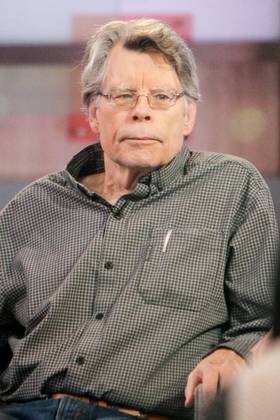
- Birthdate
-
September 21, 1947
- Birthplace
-
Portland, Maine, USA
- Height
-
6 feet 4 inches
- Professions
-
Author, Screenwriter, Producer, Director, Actor
