 JuicyTalk
Over the past year, AI agents have evolved from merely answering questions to attempting to get real tasks done. However, a significant bottleneck has emerged: while most agents may appear intelligent during a conversation, they often ‘drop the ball’ when it comes to executing real-world tasks.
Whether it’s an office workflow that breaks when requirements change, or a content creation task that feels like starting from scratch with every edit, the issue isn’t a lack of model intelligence—it’s the lack of sustained execution capability.
Recently, the openJiuwen community released JiuwenClaw. It doesn’t aim to be the “most conversational” agent; instead, it focuses on a more critical question: Can an AI agent take a task from start to finish?
I. A Watershed Moment for AI Agents: Who Can Truly Complete Complex Tasks?
1. Dynamic Office Scenarios: Adapting to Change, Not Just Steps
In a typical Excel task, a user might start by organizing a table, then suddenly ask to remove duplicates, then add a summary, and finally change the output format. Traditional agents often treat every change as a brand-new task, losing context and repeating work.
JiuwenClaw acts as a true “executor”:
- Supports task interruption, insertion, reordering, and removal.
- Maintains focus on the goal despite changes.
- Provides a visible, controllable, and adjustable execution process.
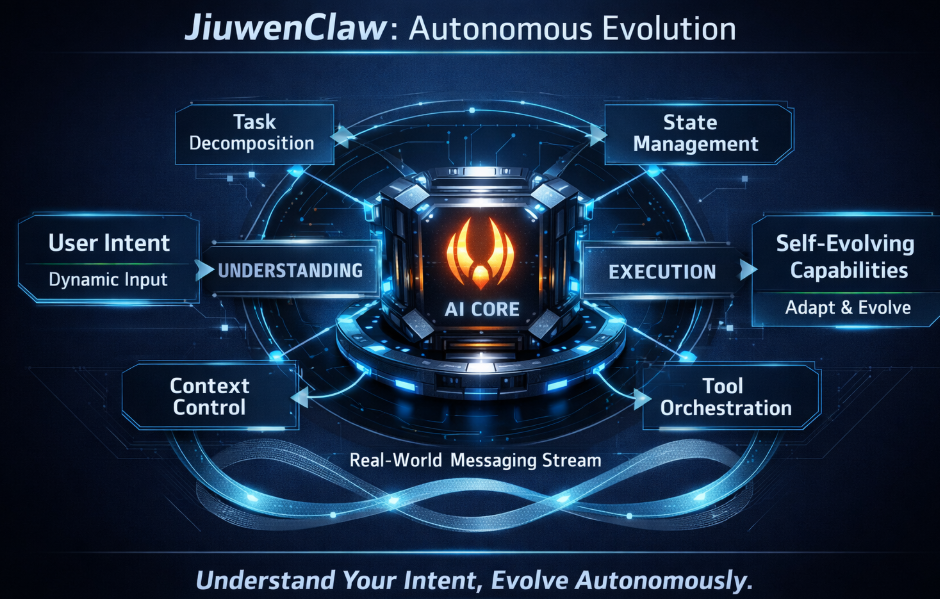
This corresponds to its first core capability: Intelligent Task Planning: Not simply breaking down steps but continuously managing task status and priorities.
When faced with complex inputs—task additions, interruptions, modifications—JiuwenClaw precisely understands intentions, intelligently schedules, and completes every goal methodically.
2. Content Creation: Overcoming the Iterative Refinement Challenge
In real-world content creation, the workflow is inherently iterative—involving title brainstorming, tone adjustments, structural reorganization, and localized rewrites. The primary failure mode for traditional agents is Contextual Amnesia: with every minor edit, the agent effectively “resets the session,” losing the subtle nuances of the previous draft.
JiuwenClaw disrupts this pattern by maintaining multi-layered Contextual Integrity:
- Granular Edit Understanding: It identifies which specific layer (structure vs. tone) is being modified.
- Style & Structure Preservation: It maintains consistency across multiple iterations.
- Continuous Progression: It builds upon the existing draft rather than generating from scratch.
This seamless experience is powered by the synergy of two core architectural innovations:
(1) Hierarchical Memory System
A three-layer architecture (stable identity layer, long-term background layer, dynamic trajectory layer) allows memory to accumulate and dynamically iterate with usage, enabling the AI assistant to remember your preferences and context, becoming more like a trusted old friend over time.
(2) Intelligent Context Slimming
Proprietary context offloading technology automatically compresses redundant information while retaining key context, ensuring Agents run stably for extended periods, avoiding Token explosions and significantly reducing usage costs.
The Result: A definitive answer to the “Stability vs. Duration” trade-off—enabling long-horizon tasks that are both memory-accurate and computationally sustainable.
(3) Real-World Automation: Bridging the Gap with “Environmental Realism”
The market is saturated with browser-based agents, but most are relegated to “toy demos.” They suffer from a critical flaw: they operate in isolated, “clean” virtual browsers.
In real-world deployments, this creates a context gap. Without an existing login state, active Cookies, or user identity headers, every interaction is treated as a “stranger login.” This triggers aggressive anti-bot measures, frequent CAPTCHAs, and ultimately, a near-zero success rate for complex automation.
JiuwenClaw takes a pragmatic, Engineering-First Approach: directly taking over the local browser environment, automatically acquiring logged-in accounts, browser Cookies, local cache, and other Profile information, bypassing verification codes and repeated logins to execute tasks in real business systems.
Automation is only useful if it works in the messy, authenticated environments of the real world. JiuwenClaw bridges the gap between a “mock-up” and a reliable production tool.
II. The Key Differentiator: Can Agents Evolve and Become Smarter?
The fundamental limitation of most current AI agents is their static nature—their capabilities are essentially “frozen” the moment they go live.
- Tool Failure: Results in a simple error log and nothing more.
- User Correction: Ignored; the same mistake is repeated in the next session.
- Skill Deployment: Once coded, the logic remains rigid and unchanging.
JiuwenClaw disrupts this pattern by introducing a critical architectural mechanism:
Autonomous Skill Evolution: Powered by the openJiuwen Self-Evolution Framework, JiuwenClaw autonomously refines its own Skills. When a tool call fails or when the user provides negative feedback (e.g., “That’s incorrect,” or “Try a different approach”), the system proactively logs the execution error and feedback. It then performs a root cause analysis (RCA) to generate targeted optimization strategies.
In essence, JiuwenClaw establishes a high-fidelity Execution-to-Learning Closed Loop: Execution → Failure → Learning → Optimization → Re-execution
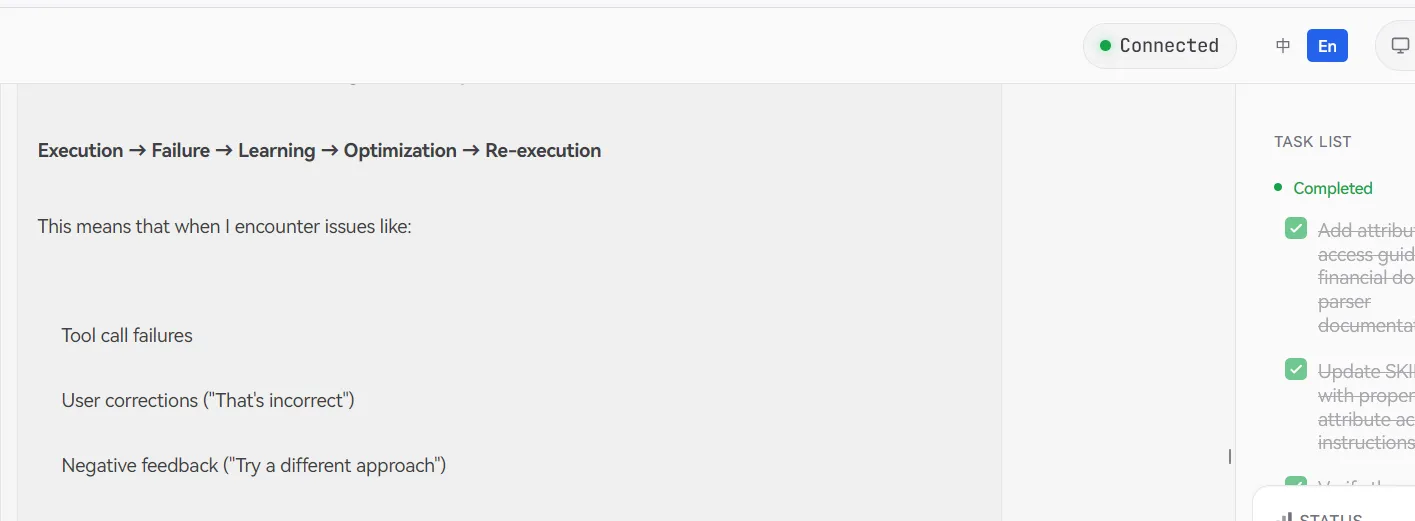
This paradigm shift means the agent is no longer a static collection of tools, but a continuously evolving system that grows more aligned with user intent through every interaction.
III. Integration into Daily Workflows: AI Agents Enter the Real World
The fundamental barrier for many agents is not raw capability, but accessibility within native user scenarios. Most agents remain isolated silos, detached from where the actual work happens.
JiuwenClaw solves this issue through a critical architectural design:
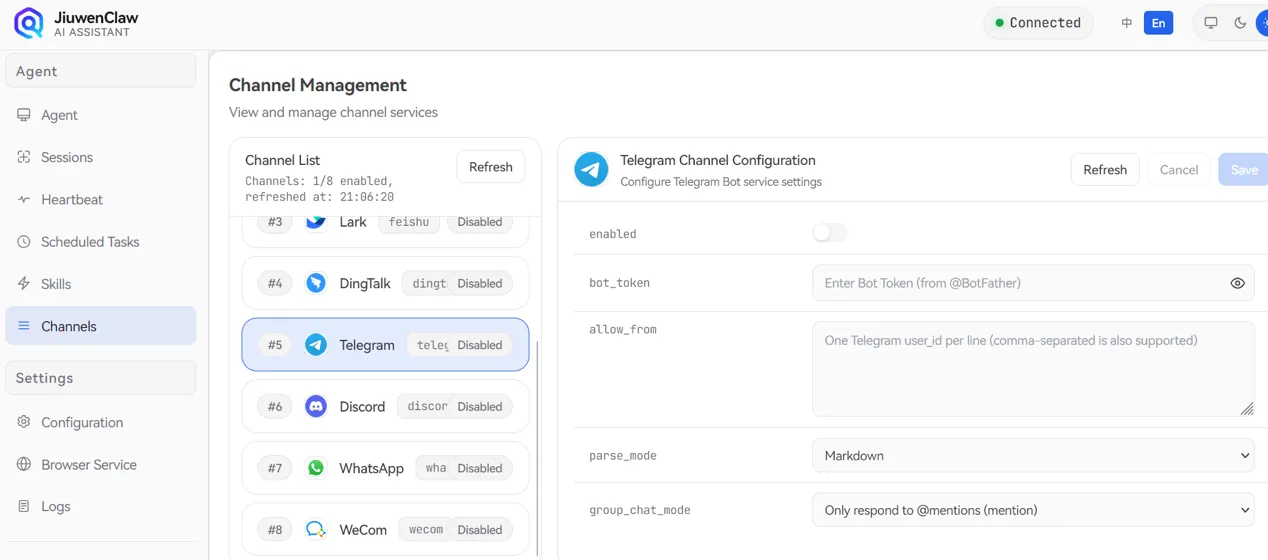
- Multi-Channel Seamless Access: It natively supports Huawei Celia (Xiao Yi), Telegram, WhatsApp, Feishu (Lark), and Web. This enables users to trigger their dedicated AI assistant from any environment.
- Data Sovereignty: By supporting Private Deployment, it eliminates concerns over data privacy and cross-border data flow, ensuring a zero-friction enterprise adoption.
This design shifts the paradigm: the agent is no longer a destination you visit (like a standalone website), but a persistent layer embedded within daily communication and professional workflows.
IV. JiuwenClaw is More than Just an Agent
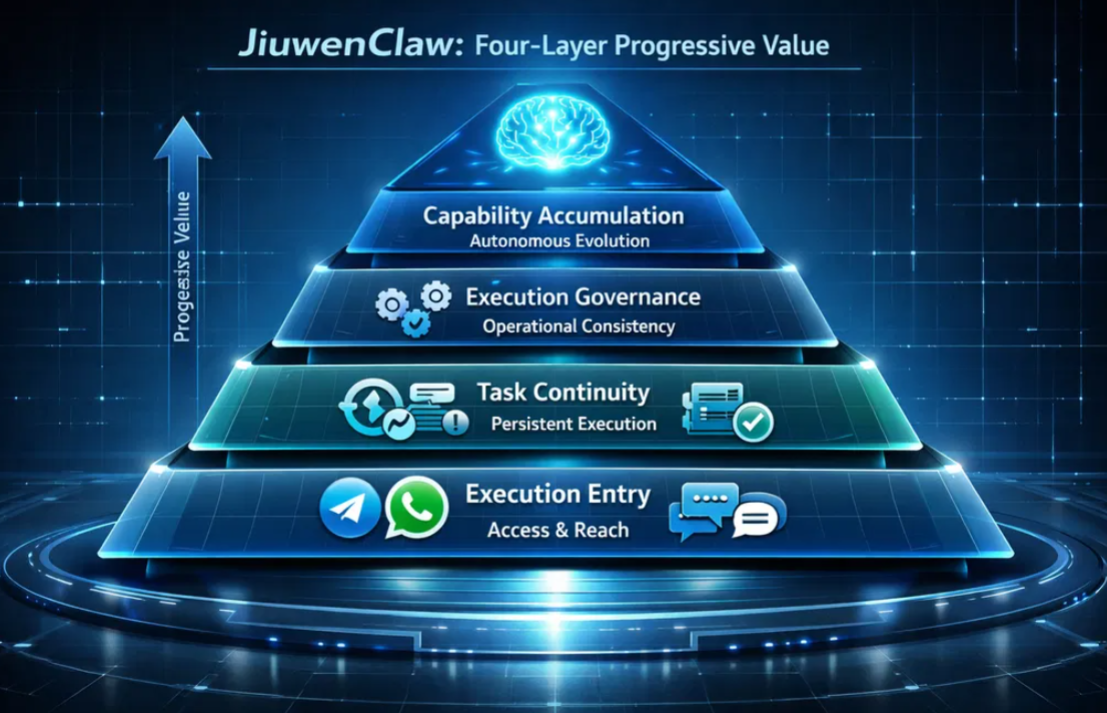
When we synthesize these capabilities, a clear Architectural Hierarchy emerges. JiuwenClaw isn’t just a monolithic tool; it is a multi-layered execution engine:
| Layer | JiuwenClaw’s Solution |
| Entry Layer | Multi-platform access for real-world usage scenarios. |
| Execution Layer | Task planning to ensure workflow continuity. |
| Stability Layer | Context management + Memory system for long-haul tasks. |
| Evolution Layer | Autonomous evolution to get smarter with every use. |
The convergence of these four layers signals a fundamental strategic shift: AI agents are evolving from “dialogue-based systems” to “high-fidelity execution systems.”
V. Industry Shift: From “Chat-Centric” to “Execution-Centric” AI
Over the past two years, the AI sector has been dominated by a “Turing Test” obsession: Who is smarter? Who sounds more human? Who scores higher on LLM benchmarks? However, we are now witnessing a Paradigm Shift where the core metric is no longer eloquence, but the Task Completion Rate. JiuwenClaw’s architecture marks a shift toward process-aware intelligence:
- Beyond Problem Understanding: It internalizes the entire Task Lifecycle, recognizing that intent is dynamic, not static.
- Beyond Response Generation: It maintains Execution Momentum, ensuring that the agent doesn’t just “talk” about the solution but actively drives the workflow to completion.
- Beyond Tool Calling: It focuses on Environmental Results, operating within messy, non-idealized real-world systems rather than sanitized sandboxes.
Conclusion: Entering the Era of the Reliable Executor
The next frontier of AI agent competition has officially moved beyond the “Chatbot” era. We are entering the era of the reliable executor.
JiuwenClaw is not merely a collection of features; it is a specialized, Production-Grade Architecture built for:
- Sustainability: Long-running tasks that don’t degrade over time.
- Adaptability: Resilience in the face of shifting user requirements.
- Evolution: A self-improving skill set that reduces manual prompt engineering.
If this trajectory holds, the agents that survive the next wave of AI adoption won’t be the most eloquent ones—they will be the ones that get the job done.
Join the Community & Explore openJiuwen
openJiuwen Download Links
JiuwenClaw Download Links
Note: “Thanks to the OpenJiuwen team for the thought leadership/resources and supporting and sponsoring this article.”


