 JuicyTalk
Over its ten years of publication, Boruto has proven incredibly divisive for Naruto‘s fanbase, but it’s much stronger than many fans think. 2026 is proving to be a promising year for the original series, with details finally materializing around Naruto‘s long-awaited return in 2027. Naturally, after a few difficult years, the wait is excruciating to see more of the iconic shōnen that defined countless childhoods and that lives in the hearts of untold anime fans.
When it comes to bridging the gap until then, Naruto fans have plenty of manga to choose from to scratch the itch. However, the irony is that the best way to fill the gap is by going directly to its sequel.
The fact is that Boruto is incredibly good on its own terms. While many Naruto fans have misgivings about it, many of those misgivings are simply misguided or misinformed. From the franchise’s tightest storytelling in many years to a cast comprising some of its most compelling characters yet, Boruto is already a fantastic series with nowhere to go but up.
Boruto Makes Naruto’s Controversial Ending Work
To start: Naruto has one of the most infamous endings in anime history. The most significant problem is the sudden introduction of the Otsutsuki clan, which at the time seemed to be a bizarre sci-fi excursion for a series which had so far been grounded in a refined set of mechanics—however faulty in places. Naruto closed the Fourth Great Ninja War with a number of brand-new ideas that seemingly had few places to go.
Suppose one wants to create a sequel after an ending like Naruto‘s. There are basically two choices: the first is to find a way to basically retcon the massively consequential Otsutsuki clan out of existence; the second is to keep rolling with that foundation and look for how to make the clan work. Boruto decided to do the latter, and it does it well.
Boruto links the Otsutsuki to an entire clan’s politics and hierarchy, fleshing them out immensely. They’re given an entire goal and reason for existence in Boruto‘s plot that, frankly, is far more convincing—and compelling—than what Naruto offered for them in its ending. Furthermore, Boruto augments some of Naruto‘s basic ideas like the jinchuriki, turning them into something workable with the Otsutsuki clan’s presence.
A lot of people might turn up their nose at the Otsutsuki’s prevalence in Boruto, but the respective members of their clan have so much dimension and bring so much to the plot that they feel like full-fledged Naruto universe characters, rather than last-second additions.
Boruto Resets Naruto’s Power Scaling Problems

Madara is undoubtedly one of anime’s best villains of all time, but by the time he appeared in Naruto, the book was basically closed on the series’ power-scaling. Even freshly reincarnated, Madara was a force to be reckoned with; by the time he obtained the Ten-Tails, he represented a wall that was only really surmountable by, well, a villain like Kaguya.
Boruto handles this in a peculiar way, by taking advantage of the sequel’s time-skip and new antagonists to essentially adapt to the absurd chakra output of later Naruto. Two examples that many people misunderstand from afar are scientific ninja tools and chakra absorption. Each serves to level the playing field, in a manner of speaking—while everybody can be quite strong, and is quite strong, it’s no longer strength and chakra reserves alone that decide the outcome of a fight.
Instead, Boruto revives early Naruto‘s emphasis on strategy and meticulous planning to win battles. In combination with battles that reach a new level of high risk and reward, the combat feels weighty. At the same time, heroes and villains alike are able to feel imposing and even overpowered while still feeling finitely beatable. Generally, even the strongest powers are given grounded caveats and conceits that make them feel both grounded (by Boruto‘s standards) and vulnerable. The end result is battles whose biggest moments feel properly earned.
Naruto’s World Feels Alive Again In Boruto

One of the chief problems with Naruto, particularly when moving into Shippuden territory, was always the day-to-day aspects of life and political operations in the robust world its first half had built out. While Naruto had a sprawling and worthy story to tell in its own right, that story required it to stray from actually addressing much of the day-to-day life that many fans found so enamoring in the first place. In effect, Naruto‘s later world building suffered.
It wouldn’t exactly be fair to say that Boruto does world building better or worse than Naruto; they go hand-in-hand, and without Naruto‘s groundwork, Boruto would have nothing to build atop. What would be fair, though, is saying that Boruto sharply draws focus back to the way the franchise’s broader battles are intimately intertwined with the day-to-day minutiae of life in ninja villages.
A fair amount of Boruto‘s earliest chapters, for example, are spent examining how technological progress has changed Konoha into a relative metropolis, connecting that newness with the simultaneous invention of scientific ninja tools. A recent chapter also recalls Naruto‘s daimyou, the lordship class whose absence was sorely felt in Naruto Shippuden—appearing to raise the question of the validity of Hidden Villages in the midst of a major interrogation.
Boruto‘s focus is incredibly tuned into Konoha as a village, its politics, the families and clans within, and what it means to live there in the face of new challenges. This refreshing change harkens back to early Naruto‘s emphasis on bureaucracy and life in the Hidden Villages, and it’s a major change for the better.
Boruto’s Writing Has Room To Breathe

Like all of anime’s Big Three, Naruto was published and aired in a very different climate from today that encouraged a likewise different mode of storytelling. The upside of Naruto‘s years of publication demands and anime filler is that the world had quite a long time to be filled out. Although its story could sometimes meander, Naruto had the good graces of a period that encouraged meandering as long as it was put toward something useful and which held readers’ (or viewers’) attention for another week.
Boruto had the home field advantage of coming in as a new series that could substantially build on the bedrock that its predecessor had provided. Combine that with its choice to adopt a monthly publication schedule, and the end result is that Boruto chapters feel very focused and intentional. That’s not to say that Naruto didn’t—it absolutely did, especially in its manga iteration—but Boruto has more room to make the most of what Naruto provided.
As a result, Boruto‘s writing decisions can work quite well. When the story wants to focus on a battle, the long chapters and high page count provide the real estate for well-choreographed, meticulously drawn battles. When it instead wants to focus on characters or narrative progression, dialogue is given room to breathe and, often, channeled in a way that avoids Naruto‘s sometimes ham-fisted (or over-reliant on flashbacks) approach.
Boruto Doesn’t Try To Be Naruto 2.0

Earlier, when talking about Naruto‘s controversial ending, one major problem went unmentioned: Naruto‘s reincarnation twist, which would undermine the underdog dynamics, not to mention the themes of hard work and determination, that the series had already spent years developing. This point isn’t for nothing, because it’s effectively rendered moot in Boruto.
Consider Boruto and Kawaki. Although the pair seem like a parallel to Naruto and Sasuke, the apparent heirs of a troubled reincarnation in Naruto, Boruto makes it clear very early on that their dynamic couldn’t be further from Naruto‘s beloved duo’s. While it’s easy to assume that Boruto exists to replicate Naruto‘s dynamics and success, it doesn’t at all. While Boruto and Kawaki are set up as rivals, their earnest fraternity and eventual existential divide drive at fundamentally different themes.
The point is that even in its core duo, Boruto doesn’t take Naruto‘s blueprint for granted. Someone looking at Boruto looking for Naruto might not find it—but that might just be the big mistake. For example, Boruto‘s Kara obviously shares a parallel to Naruto‘s Akatsuki, being a renegade organization outside the law, but their origins and meaning within the story couldn’t be more different.
Likewise, Boruto shares cast members with Naruto, but what many people call the original cast’s underrepresentation is actually Boruto forging its own path: it has its own standout cast with characters like Sarada Uchiha and the offspring of Team 10, who only grow more compelling as the series develops. Naruto‘s cast, like Shikamaru and Konohamaru, serve as supports to get these new personalities off the ground and let them shine in the greater story, the same way (arguably underexplored) characters like Asuma and Ebisu once did for them.
The chief problem is looking at Boruto expecting Naruto all over again. The franchise has never aspired to that. Instead, its aspirations are in its name: to be the next generation of Naruto. No child is exactly like their parent. Taken on its own terms, as a story in its own right, Boruto‘s resilience to just doing Naruto all over again is its greatest strength, by sheer virtue of not being preloaded with thematic and narrative baggage: it is simply the next generation, and that’s that.
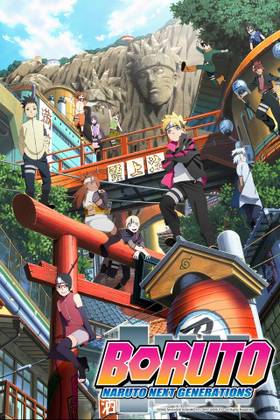
- Cast
-
Yûko Sanpei, Amanda Miller, Kokoro Kikuchi, Junko Takeuchi, Noriaki Sugiyama, Saori Hayami, Ryuuichi Kijima, Yuuko Kaida
- Created by
-
Masashi Kishimoto, Ukyo Kodachi, Mikio Ikemoto


