 JuicyTalk
Fantasy movies have a tougher job than most genres. Before audiences can invest in the characters or follow the story, they first have to believe in a world governed by magic, monsters, ancient prophecies, or entirely unfamiliar rules.
The best fantasy movies begin building that world before anyone has spoken a line. A great opening can establish scale, danger, beauty, or mystery in a matter of seconds. It may introduce a kingdom under threat, reveal an ordinary hero before everything changes, or create an artifact so striking and powerful that viewers are pulled into the story without needing an explanation.
From the dusty roads of Kansas to the highest peaks of Middle-earth, these fantasy movie openings transport audiences somewhere unforgettable from the very first frame.
10
Willow (1988)
While Willow eventually becomes a warm, playful adventure, its opening offers no hint of safety. Ron Howard plunges the viewer into the shadow of Castle Nockmaar, the fortress ruled by the merciless Queen Bavmorda. Surrounded by fog, black rock, and a bruised sky, the castle seems less constructed than carved out of the mountain itself.
Placing the audience at the center of Bavmorda’s power establishes an immediate threat before we even meet Willow Ufgood or see the peaceful Nelwyn village he calls home. The fortress hangs over everything that follows, even when it is no longer visible. George Lucas wanted Willow to feel like a classical fairy tale on an epic scale, and the grim silhouette of Nockmaar provides the necessary darkness to make the warmth to come feel earned, and why the movie itself has aged like fine wine.
9
The Chronicles Of Narnia: The Lion, The Witch And The Wardrobe (2005)

Rather than jumping straight in with fantastical talking animals, The Lion, the Witch and the Wardrobe opens over London during the Blitz. German bombers cut across the night sky before releasing their payloads onto the city below, sending the Pevensie children scrambling for shelter.
The sequence grounds the fantasy in a frightening historical reality. Peter, Susan, Edmund, and Lucy are not simply bored children looking for adventure. They have been separated from their mother and sent away because the world around them has become dangerous. That context makes their discovery of Narnia feel like more than an escape into a magical game. It is a refuge, although they soon learn that this new world is also trapped in a war of its own.
8
Spirited Away (2001)

Hayao Miyazaki introduces Spirited Away with something completely ordinary: a bouquet and a farewell card. 10-year-old Chihiro lies across the backseat of her parents’ car, staring unhappily out the window as the family drives toward their new home. The image tells viewers exactly who Chihiro is at the beginning of the story.
She is sulky, anxious, and resistant to change, with no idea that she is about to enter a world filled with witches, spirits, dragons, and gods. Starting with such a familiar childhood experience gives the movie its emotional anchor. No matter how strange the bathhouse becomes, the story remains tied to a frightened girl who wants to return to the life she knows. Her first appearance also gives the audience a clear measure of how much she changes by the end.
7
The Wizard Of Oz (1939)

A wide, unsettled sky looms over the empty Kansas road that serves as the starting point for Dorothy Gale’s journey. Dorothy and Toto appear as tiny figures in the distance, cutting through a dusty, sepia-toned landscape that feels dry, flat, and entirely drained of possibility. This deliberate visual restraint effectively boxes Dorothy into a world that feels too small for her, setting the stage for the massive transformation to come.
That bleakness is the engine behind the movie’s most iconic transition. Dorothy’s longing to be “somewhere over the rainbow” feels so profound because the monochromatic Kansas reality is so oppressive. When she finally opens the farmhouse door to step into the Technicolor brilliance of Oz, the contrast is jarring and miraculous. The Technicolor jump is iconic, but the heart of the moment lies in that simple opening image—a girl searching for where she truly belongs.
6
Harry Potter And The Deathly Hallows – Part 2 (2011)

The final Harry Potter movie opens with Severus Snape standing alone inside Hogwarts. Framed by a tall stone window, he looks down as students march across the courtyard in rigid formation while Dementors circle the school. The color has nearly disappeared from the image, leaving Hogwarts trapped in shades of blue, gray, and black.
It is a startling contrast to the wonder that once defined the castle. Hogwarts has become a prison, and Snape appears confined within it even though he is technically in command. Alan Rickman’s expression gives away very little, but the sorrow beneath his stillness becomes more apparent once the truth about Snape is revealed. Paired with Alexandre Desplat’s “Lily’s Theme,” the opening establishes the grief hanging over the final chapter before Harry even appears.
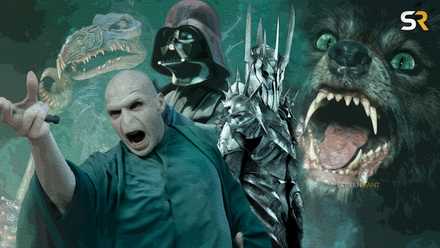
10 Greatest Fantasy Movie Villains Of All Time, Ranked
Fantasy villains are built differently. We’re ranking the 10 most iconic dark lords and nightmare creatures that outclass every superhero bad guy.
5
Excalibur (1981)

John Boorman’s Excalibur begins in a fog-covered forest where knights clash beneath the trees. Their polished armor catches the orange torchlight and the strange green glow surrounding them, turning the battle into something closer to a nightmare than a historical reconstruction.
The opening makes it clear that Excalibur is not interested in presenting the Arthurian legend as conventional medieval history. Boorman’s world is violent, dreamlike, and ruled by forces older than the people attempting to control them. The knights barely resemble ordinary men as they move through the mist in their reflective armor. They appear like figures summoned from myth, already trapped inside a cycle of war, ambition, and betrayal. Before Merlin arrives or the sword is drawn from the stone, the movie has established a Britain caught between brutality and magic.
4
Edward Scissorhands (1990)

A dark castle rises above the bright suburban neighborhood at the beginning of Edward Scissorhands. The mansion is gothic, isolated, and surrounded by snow, while the houses below are arranged in neat rows of pink, yellow, blue, and green. That juxtaposition continues throughout the entire movie.
Tim Burton places two incompatible worlds within the same image: the romantic darkness of Edward’s home and the artificial cheerfulness of the community that will briefly embrace him. The castle looks lonely but imaginative, while the suburb appears welcoming until its conformity becomes threatening. Edward has not yet appeared, but the geography already explains why he will struggle below. He can physically see the neighborhood from his home, yet there is no obvious place for someone like him inside it.
3
Pan’s Labyrinth (2006)

Darkness swallows the screen before a dying girl appears, only for time to reverse, pulling her back from the brink of death. The blood retreats, her body begins to recover, and time moves backward to the beginning of her story. Guillermo del Toro reveals Ofelia’s apparent fate within the opening moments, but the decision does not weaken the movie’s suspense. It changes the question.
Rather than wondering only what happens to her, the audience begins asking what her death will mean and whether the fantasy world she discovers offers another form of life. The reversed blood also establishes that this story will not obey ordinary boundaries between reality, imagination, life, and death. It is disturbing, beautiful, and perfectly suited to a movie in which a fairy-tale wonder exists beside human cruelty.
2
Star Wars: Episode IV – A New Hope (1977)

After the opening crawl disappears into space, a small Rebel ship races over Tatooine. The tip of an Imperial Star Destroyer then enters the frame behind it. The ship continues moving overhead until its enormous mechanical underside seems to swallow the screen. The difference in scale explains the central conflict without dialogue. The Rebels are small, vulnerable, and desperately outmatched, while the Empire appears powerful enough to block out the stars.
Although Star Wars takes place in space, its story is rooted in fantasy: a princess is captured by a dark lord, an orphan receives a magical inheritance, and an elderly wizard sends him on a quest. The first scene gives that familiar mythology an unprecedented sense of size. George Lucas does not have to mansplain to the audience how powerful the Empire is. The Star Destroyer makes them feel it.
1
The Lord Of The Rings: The Two Towers (2002)

The serene, snow-dusted peaks of the Misty Mountains are shattered by a sudden, jagged descent. As Gandalf’s voice and the Balrog’s guttural roar echo from the deep, the camera plunges headlong into the mountainside, dragging the audience back to the final moments of The Fellowship of the Ring.
Peter Jackson could have opened the second movie with a standard recap or cut straight to Frodo and Sam. Instead, he revisits Gandalf’s fall from a new perspective, transforming a presumed death into an extended battle through the depths of Middle-earth. The shift from pristine ice to the fire and darkness below captures the scale of Tolkien’s world in seconds, and this is why it takes the top spot. It’s a jarring, brilliant defiance of sequel convention; Jackson understood the weight of his narrative, and he knew exactly how to weaponize it.

- Release Date
-
December 18, 2002
- Runtime
-
179 minutes
- Writers
-
Fran Walsh, Philippa Boyens, Peter Jackson, Stephen Sinclair, J.R.R. Tolkien
- Producers
-
Barrie M. Osborne, Bob Weinstein, Harvey Weinstein, Mark Ordesky, Peter Jackson, Robert Shaye


