 JuicyTalk
Hulk has been smashing his way through the pages of Marvel Comics for more than 60 years, and here’s the best places to start reading his books. Debuting in 1962, Old Jade Jaws’ first title was canceled after only six issues. He was given new life as a featured character in Tales to Astonish, and the rest was history.
Dr. Bruce Banner’s gamma-powered alter-ego has become a cornerstone of the larger Marvel universe, including appearances on the small and large screens. With Hulk due to appear in the upcoming Spider-Man: Brand New Day, interest in the not-so-jolly green giant has never been higher. However, the scope of Hulk’s comic book runs can be quite intimidating.
Having appeared in nearly 2,000 comics, it’s safe to say that it would be almost impossible to read every Hulk book. Thankfully, there are jumping-on points for newcomers to make Hulk’s six-decade comic run more accessible. As long as you have a basic understanding of Hulk’s origins, the emerald monster’s books are pretty easy to pick up and read.
The Immortal Hulk (2018-2021)
Hulk had grown somewhat stale throughout the 2010s, but Al Ewing’s reimagining completely changed the trajectory of the character. The Immortal Hulk transforms the character into a bona fide nightmare, dipping more into horror than conventional superhero storytelling. Hulk can’t die, and that has dire consequences for Bruce Banner and those in his orbit.
The art by Joe Bennett is stellar, and the 50-issue run has a consistent vision from start to finish. It’s a departure from Marvel’s usual fare, but it’s still an excellent starting point for newcomers. It hearkens back to the original existential tone of the character, but it pulls it off so much better than its Silver Age counterpart.
Planet Hulk & World War Hulk (2006-2007)

Marvel writers gave Hulk his very own crossover event with the “Planet Hulk” storyline, and that immediately led into the “World Work Hulk” arc. Fed up with Hulk’s unstoppable rampages, a band of Marvel heroes decide to send him into outer space. Unfortunately, he lands on a violent planet called Sakaar, where he learns to be an intergalactic gladiator.
This storyline leads right into “World War Hulk”, where the title character finds his way back to Earth and exacts his revenge against the faction that shipped him off. While “Planet Hulk” is somewhat self-contained, “World War Hulk” stretches across multiple titles, and is a nice introduction to the larger Marvel Comics universe.
It’s a good starting point because it’s a well-written storyline, and because it helped shape the next decade of Hulk comics. Many major moments in the “Planet” and “War” stories are still part of Hulk’s lore, and they partially inspired elements of Thor: Ragnarok.
Hulk #1 (1999)

After the decades-long run of The Incredible Hulk volume two, Marvel moved the character over to Hulk volume one. The series debuted in 1999, and was a soft continuation of the previous era, but with a recap for those who might have missed something between then and 1962. John Byrne lent his pen to most of the 11-issue run.
Hulk volume one is a pretty bog-standard stretch for the green goliath, but it leads directly into the next decade or more of Hulk stories. It’s a great starting point because it’s closer to modern comics in its execution. Hulk’s older appearances might be less interesting to modern readers, but the 1999 series isn’t as likely to scare them away.
Peter David’s Epic Saga (1987-1998)

Other great writers have made their mark on Hulk comics, but none have matched the epic scope of Peter David’s 12-year tenure. Taking over the pen in 1987, David ushered Old Jade Jaws through his most intriguing and metatextual period. He introduced several of Hulk’s alter-egos (including Joe Fixit), and set the overall tone for the character for decades.
Most importantly, David built on top of what previous writers had toyed with, altering Banner’s backstory to include abuse and mental illness. The run is long, but it features multiple arcs and storylines to keep the reader engaged. Previous knowledge of Hulk isn’t necessary, and so it’s an excellent starting place that doesn’t require any homework.
The “Crossroads” Storyline (1984-1986)

Bill Mantlo’s writing tenure on The Incredible Hulk is often overshadowed by Peter David’s, but he deserves credit. His lengthy story arc, “Crossroads”, is really where the Hulk character turns a corner and becomes modern. It’s essentially the trial run for “Planet Hulk” and “World War Hulk” and has a very similar plot to that later saga.
Hulk becomes a mindless monster and is sent into various dimensions to do battle. The storyline is quite cerebral, with Bruce Banner’s trauma taking center stage for the first time. Hulk newcomers will learn everything they need to know about the character from “Crossroads”, and can continue on from there or bounce around to other storylines.
Len Wein’s Trippy ’70s Run (1974-1978)

Bronze Age Hulk comics suffer from a lot of the same problems as other Marvel books, but Len Wein’s run on The Incredible Hulk is a highlight. Wein brings an imaginative angle to the character, often sending him into outer space or to other dimensions. Underneath all the zaniness is the first glimpse at something more behind the character.
Wolverine’s first appearance comes in The Incredible Hulk #180.
Wein’s run introduces Wolverine into the Marvel mix, perhaps his most famous creation. Though his run isn’t strictly episodic, it does feature a compelling arc where Banner’s search for a cure leads him to heartbreak. Wein’s era is the perfect starting point for fans of old school comic writing, and there are some legitimately amazing standalone issues from his tenure.
The Incredible Hulk Issue #102 (1968)

For all intents and purposes, The Incredible Hulk #102 is where the decades-long original Hulk run begins in earnest. The book was retitled from Tales to Astonish, but it kept the previous books’ numbering scheme. Though it picks up right where TTA left off, it’s Hulk’s return to a full book format for the first time in years.
For those looking to get the most out of their Hulk experience, #102 is the ideal starting position. The growing pains are out of the way, and the book runs uninterrupted until 1999. The Incredible Hulk #102 starts a stretch that goes on for hundreds of issues, sure to keep even the most voracious reader entertained for a long time.
The Tales To Astonish Era (1964-1968)

After Hulk’s six-issue debut run, he was demoted to an anthology title called Tales to Astonish. Starting with issue #60, Hulk would share the book with the likes of Ant-Man and Namor the Submariner for four years. Each story in TTA is about half the length of a traditional comic, making them quickly digestible.
Though this era is often overlooked, it’s a seminal period for the Hulk mythos. Various iconic villains are introduced, such as his arch-nemesis, The Leader, and it’s where the Hulk formula is really ironed out. Tales to Astonish is not for everyone, but it’s the best starting point for fans of comic book history.
The Very Beginning (1962)

Starting with The Incredible Hulk issue one is not advisable for every reader, but it is a good place to start for completionists and fans of early Marvel. The initial six-issue run, penned by Stan Lee and drawn by Jack Kirby, tells the story of the Hulk’s origins and his initial battles against Thunderbolt Ross and the army.
The Incredible Hulk Volume 1 | ||
|---|---|---|
Book Title | Issue Numbers | Years |
The Incredible Hulk | 1-6 | 1962 |
Tales to Astonish | 60-101 | 1964-1968 |
The Incredible Hulk | 102-474 | 1968-1999 |
The writing is corny and repetitive, but there is a simple charm to the Silver Age books. Hulk’s original gray color is an interesting twist, and the early issues really put over the terror of the title character. Jack Kirby’s art alone is a fine selling point, and it’s neat to see Hulk‘s origin before it is retconned again and again across the decades.
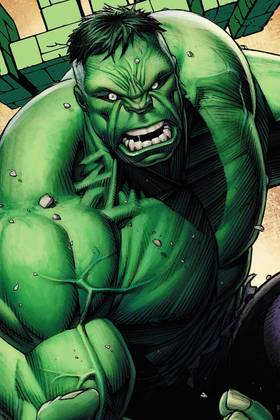
- First Appearance
-
The Incredible Hulk (1962)
- Alias
-
Robert Bruce Banner
- Alliance
-
Avengers, Defenders, Horsemen of Apocalypse, Fantastic Four, Pantheon, Warbound, S.M.A.S.H., Secret Avengers
- Franchise
-
Marvel


